
US Logistics Update [Sep 19, 2026]-English

At its Federal Open Market Committee (FOMC) meeting on the 16th, the Federal Reserve (Fed) raised the benchmark interest rate by 0.25 percentage points to a range of 3.75% to 4.00% per annum, marking its first rate hike in over three years and two months since July 2023. Fed Chairman Kevin Warsh cited the following reasons for the Fed’s shift from its July stance of holding rates steady to raising them this time: (1) the U.S. economy has strengthened; (2) inflation remains high; and (3) the geopolitical situation has changed. Chair Warsh also noted that “it is difficult to describe current financial conditions as tight, and this move simply removes some of the easing,” leaving the door open for future rate hikes. Fed officials also indicated in the Summary of Economic Projections (SEP) dot plot—a chart published quarterly that plots Fed members’ interest rate projections as dots—that the median interest rate for the end of this year is 4.1%, suggesting that rates could be raised one more time in the future.


Meanwhile, Chairman Warsh stated that he believes the robust rebound in the U.S. economy—including the job market—demonstrates fundamentals strong enough to withstand interest rate hikes. He expressed optimism regarding the recent sharp rise in Treasury yields, noting that, contrary to concerns, it reflects expectations for economic growth and the AI investment boom. Furthermore, as he had announced, the press conference following the FOMC meeting was wrapped up in just 28 minutes, with follow-up questions limited. President Trump expressed his support for Chairman Kevin Warsh despite the Fed’s decision to raise interest rates. Following the Fed’s rate hike, the sharp rise in Treasury yields subsided, and the New York stock market also rose. Furthermore, according to a report released by the U.S. Census Bureau on the 16th, U.S. consumer retail spending in August increased by 1.2% compared to the previous month—the largest increase in the past five months. Experts analyze that U.S. consumers are continuing to increase their spending despite the burden of high inflation, such as rising gasoline prices.

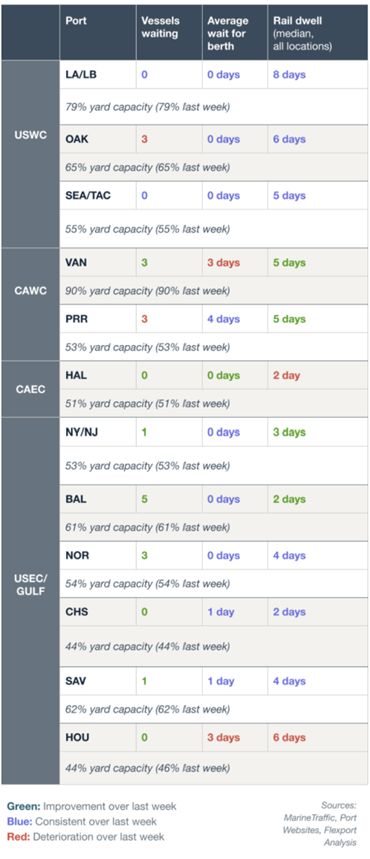
North American Vessel Dwell Times
U.S. Gasoline and Diesel Prices Continue to Rise; Diesel Prices Hit All-Time High
As the conflict in Iran persists, gasoline and diesel prices across the United States continue to rise. According to data compiled by the American Automobile Association (AAA), the national average gasoline price as of September 19 was $4.4759 per gallon—a significant increase from the average of $4.3104 a week earlier and $4.0860 a month ago—and continues to show a steady upward trend. Diesel prices, which directly impact the transportation industry, are rising even more sharply, with the national average reaching $6.4866—an all-time high recorded by AAA. This represents a very significant increase compared to $6.1602 a week ago and $5.5042 a month ago. Compared to $3.7060 at the same time last year, the price is nearly double. By state, California has the highest fuel prices in the U.S. ($6.1372), a result of a combination of refining costs, environmental regulations, and tax structures. As prices for both gasoline and diesel continue to rise, this is causing direct cost increases across the entire logistics sector, including trucking and shipping. In fact, U.S. airlines are cutting back on their year-end flight routes one after another due to soaring fuel prices. Additionally, in response to the fuel price surge, the U.S. government has temporarily relaxed driving hour restrictions for truck drivers transporting gasoline or diesel. The sharp rise in U.S. diesel prices is a structural phenomenon resulting from a combination of geopolitical factors and supply shortages. This is creating a double whammy: fuel surcharges are rising, and the risk of bankruptcy for small and medium-sized trucking companies is increasing, leading to a contraction in spot market capacity.

IEEPA Tariff Refund Update
The U.S. Customs and Border Protection (CBP) announced in a Declaration filed with the U.S. Court of International Trade (CIT) on the 15th that CAPE Phase 3 will take effect on October 6, 2026, marking a new turning point for U.S. IEEPA tariff refunds. In other words, this outlines CBP’s specific operational guidelines for “finally liquidated entries”—which had been pending—and it is expected that the implementation of Phase 3 will conclude most refund procedures. The refund procedures, categorized by the status of each entry, are as follows:
Entries that are unsettled or within 80 days of settlement
Refund procedures can proceed through the existing CAPE Phase 1. CBP is currently classifying entries that have not yet been settled or are within 80 days of settlement as eligible for refunds through CAPE Phase 1.
Finalized entries more than 80 days after settlement
These are the primary targets of Phase 3. However, not all importers are eligible to apply. According to CBP’s current operational guidelines, refunds through Phase 3 are available only to importers who are plaintiffs in an IEEPA duty refund lawsuit filed with the CIT and who have received a reliquidation order from the CIT regarding the relevant entry. In particular, plaintiffs who submitted Importer of Record (IOR) information valid through July 30, 2026, to CBP may submit refund applications through Phase 3 starting October 6; however, CBP plans to provide separate guidance for plaintiffs who submit IOR information after that date. Therefore, for importers who have provided valid IOR information, the refund process for customs entries finalized more than 80 days after settlement is as follows: CIT lawsuit → Reliquidation Order → Submission of CAPE Phase 3 refund application → Refund.
Customs entries with pending protests
For entries where a protest regarding IEEPA duties is currently pending, there is no need to rush to withdraw the protest at this time. It is necessary to first confirm whether the entry is subject to CIT reliquidation and whether it qualifies for a CAPE Phase 3 refund before deciding on a final course of action. Experts recommend maintaining the current protest while monitoring future CBP guidance and the scope of CIT recalculation. Subsequently, a decision must be made for each entry—whether to maintain the protest, withdraw it, or file a CAPE Phase 3 refund claim—based on the specific circumstances of each entry.
Container Shipping Market: Oversupply Becomes a Reality as Red Sea Crisis Eases… “Inevitable Unless a Black Swan Event Occurs”
Lars Jensen, a prominent shipping market analyst, argues that the global container shipping market is entering a phase where oversupply is once again becoming a reality as the Red Sea crisis eases. In 2023, many market experts had predicted an oversupply for 2024–2025, but the Red Sea crisis—which led to ships avoiding the Suez Canal and taking detours around Africa—artificially absorbed shipping capacity, creating a temporary supply shortage. However, in recent months, 33% of total shipping capacity has returned to the Suez route, causing the supply previously absorbed by the detour routes to flow back into the market. Consequently, the underlying structure of oversupply, which had been masked by the Red Sea crisis, is once again coming to light. Lars Jensen points out that all four conditions must be met to avoid an oversupply. First, the Red Sea crisis must resurface, forcing all shipping companies to reroute via Africa again; second, 50% of vessels over 20 years old must be scrapped in 2027–2028 (approximately 1.5 million TEU annually); third, current port congestion must persist without improvement; and fourth, the demand growth rate in 2027–2028 must exceed the 6.6% recorded over the past 12 months. However, he explains that it is highly unlikely that all four of these conditions will be met simultaneously. He noted that the highest volume of scrapping on record was only 665,000 TEU in 2016, and that port congestion has historically been resolved within 3 to 4 months. He assessed that, barring a new geopolitical shock (black swan event), the market in 2027–2028 is structurally bound to face an oversupply.
U.S.-Mexico Border Trucking Rates Soar… Supply Shock Triggered by B1 Visa Crackdown
As the U.S. government has intensified crackdowns on Mexican B1 visa truck drivers, the border transportation market is facing a severe supply shortage. The supply of Mexican B1 drivers has decreased by 30–50%, causing truck freight rates for shipments to the U.S. to skyrocket by 30–70%. For example, spot rates on the Laredo–Dallas route have risen by 57%. Crackdowns on Mexican truck drivers have led to the revocation of more than 25,000 B1 visas since April 2025. Although this represents a small fraction of the total U.S. truck driver workforce, these drivers account for a very large share of cross-border transportation, leading to a direct supply shock. As a result, the actual load-to-truck ratio at the border has worsened from 5:1 to 8.5:1. Consequently, U.S. importers are shifting away from a direct-to-destination model toward a hybrid network centered on transloading and cross-docking. Structural changes are emerging, with transloading demand surging in Laredo and transloading inquiries increasing in El Paso as well. Experts describe the current border transportation market as a “tinderbox ready to explode at the slightest increase in demand” and warn that the supply shortage is becoming structurally entrenched.

CBP Implements Large-Scale Delisting of IORs
U.S. Customs and Border Protection (CBP) has implemented a large-scale delisting of Importers of Record (IORs) to enhance the accuracy of import supply chain information. In a notice dated August 19, CBP had announced its intention to verify the accuracy of Form 5106 information for both new and existing IORs, and this initiative is now being fully implemented. Form 5106 is a document that collects basic identification information on importers and companies, serving as the foundation for CBP to identify and manage entities involved in imports. This de-registration process involved automatically validating IORs containing inaccurate or incomplete information using AI-based tools and subsequently invalidating them. It is a mandatory requirement for IORs to ensure the accuracy and completeness of submitted information, such as address, email, phone number, IRS EIN, and SSN. Customs brokers are required to hold a valid Power of Attorney (POA) directly executed with the IOR. CBP has officially stated that over the past two years, it has shifted its policy focus from facilitation to enforcement; consequently, trust-based programs such as C-TPAT are transitioning from optional to mandatory requirements.

FedEx Introduces QR Code Authentication Service for High-Value Shipments
FedEx has introduced its “Authenticated Delivery” service for high-value or sensitive shipments in the United States and Canada. This service requires the recipient to present a unique QR code sent in advance by FedEx before the shipment can be delivered; it is a security measure designed to reduce theft, fraud, and misdelivery during the delivery of high-value shipments. When a shipper selects this service, FedEx sends the recipient a unique QR code and a delivery notification. Upon delivery, the recipient presents the QR code, and the FedEx driver scans and verifies it before handing over the package. FedEx emphasized that “not only delivery speed but also building trust is key to the future of shipping,” stating that this is part of a strategy to strengthen security-focused services so that customers can receive their important shipments more safely. Experts assess that FedEx’s service represents a measure that charts the industry’s direction, reflecting the full-scale implementation of enhanced delivery security in response to the expansion of the high-value shipment market, the shift from signature-based authentication to digital authentication systems, competition for service differentiation in the high-value shipment market, and a trend toward prioritizing trust throughout the delivery process.
USPS to Enforce “No Incomplete Documentation” Policy Starting October 22… Transition to a Comprehensive Regulatory System with AI-Based Full Inspections
U.S. Customs and Border Protection (CBP) has officially announced that, starting October 22, it will utilize AI-based data analysis technology to conduct full inspections of all international mail, including product descriptions, 10-digit HTS codes, and importer information. For years, the U.S. operated the de minimis regulation, which allowed low-value e-commerce mail items valued at $800 or less to clear customs with minimal documentation. However, a surge in volume created a structural limitation that prevented CBP from verifying all mail items. To address this issue, the U.S. abolished the de minimis regulation on July 30, 2025, and since then, international mail has been transported via a temporary declaration procedure. The regulatory tightening on October 22 marked a transition from the abolition of the de minimis rule → the end of the interim system → a shift to a full-fledged formal data submission system. Under this new system, CBP requires accurate product descriptions, precise 10-digit HTS codes, and accurate importer information for all international mail. If the data is incorrect, senders must expect delays, returns, or rejections.