
US Logistics Update [Oct3, 2026]-English

The U.S. Department of Commerce announced on the 30th that the Personal Consumption Expenditures (PCE) Price Index for August rose 3.4% year-over-year and 0.3% month-over-month. The core PCE Price Index, excluding energy and food, rose 3.0% year-over-year and 0.2% month-over-month. Although both the headline and core PCE inflation rates remained well above the Federal Reserve’s 2% target, the core index—which provides a broader picture of inflation trends—came in lower than the consensus forecast of Dow Jones-surveyed economists, leading to assessments that inflationary pressures are not as strong as previously feared. By category, prices for goods and services each rose 0.3% from the previous month, with rising energy prices in particular driving the August increase. Gasoline prices jumped 4.4% from the previous month, while prices for energy goods and services rose 2.3%. Transportation service prices also rose 1.4%. The PCE price index is an inflation indicator that reflects the prices of goods and services consumed by households, and the Federal Reserve uses it as a benchmark to assess whether it is meeting its monetary policy goal of a “2% inflation rate.”


Meanwhile, U.S. nonfarm payrolls for September, as reported by the U.S. Department of Labor, rose by 29,000 from the previous month, falling well short of market expectations (an increase of 84,000). The unemployment rate in September was 4.2%, a slight increase from August (4.1%). Combined with weaker-than-expected employment data and the PCE price index, as well as expectations that the Fed will not raise interest rates ahead of the midterm elections—regardless of how hawkish Fed Chairman Kevin Warsh may be—the market is optimistic that the Fed will keep the benchmark interest rate unchanged at the October Federal Open Market Committee (FOMC) meeting.

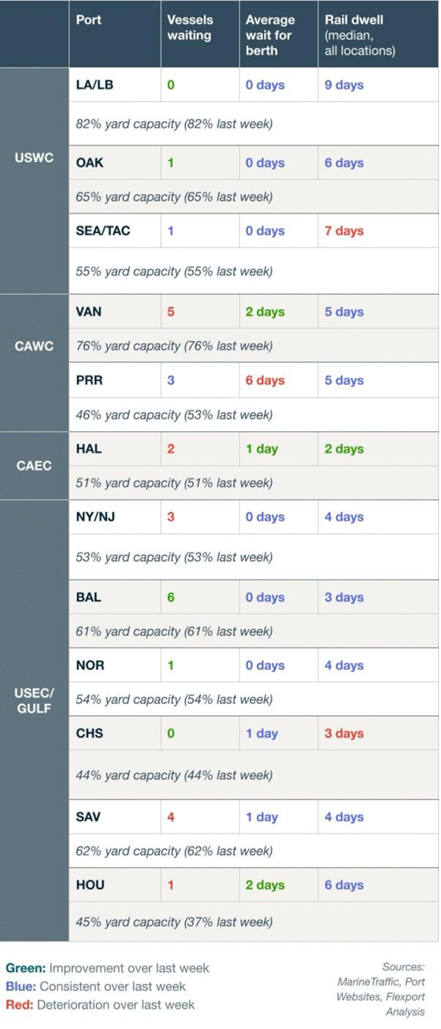
North American Vessel Dwell Times
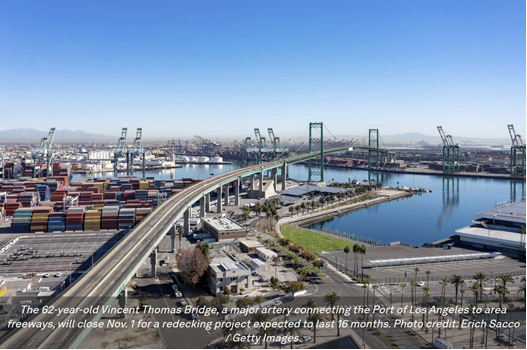
Key Bridge at the Port of Los Angeles Set to Close for 16 Months, Raising Concerns About Port Congestion
The Vincent Thomas Bridge, a key logistics artery connecting the Port of Los Angeles to major highways, is scheduled to be completely closed for approximately 16 months starting November 1 for repairs, causing significant concern within the industry. Currently, the Port of Los Angeles/Long Beach (LA/LGB) is already experiencing high dwell times for rail and truck containers, and this bridge closure is highly likely to cause delays in inland transportation and place additional strain on drayage operations. In particular, as import volumes continue to flow in during the peak season, issues such as empty container backlogs and chassis shortages are also arising, making it necessary to closely monitor logistics at Southern California ports going forward. Currently, dwell time at the LA/LGB ports stands at an average of 6.75 days for rail in August—the highest level in 17 months—while truck dwell time is averaging 2.95 days, approaching an 18-month high. Despite these conditions, U.S. import volumes continue to show strength. The National Retail Federation (NRF) forecasts that September will be the month with the highest import volume this year, and October imports are also expected to increase year-over-year. From January through August, imports from Asia at the Port of Los Angeles increased by 4% compared to the same period last year.
In the Wake of New Jersey Labor Law Reform, Changes Expected in the NY/NJ Port Drayage Market
With the state of New Jersey officially implementing the so-called ABC Test—a standard for classifying workers—the drayage industry at the New York and New Jersey ports is concerned that rising transportation costs and driver shortages will worsen. The ABC Test is a set of criteria used to determine whether a worker is an independent contractor or an employee. To be recognized as an independent contractor, a worker must meet all three of the following conditions:
Not be subject to the company’s direct control
Perform work that is distinct from the company’s core business
They must operate as an independent business entity
The New Jersey drayage industry believes that the second condition—“performing work distinct from the company’s core business”—is particularly difficult to meet in practice. As a result, drivers currently classified as independent contractors—estimated to account for up to 77% of the workforce—may be reclassified as employees, raising concerns that transportation companies will face additional costs for wages, Social Security taxes, insurance, and human resources management. In fact, when similar regulations were implemented in California, transportation companies saw a significant increase in operating costs due to the establishment of separate legal entities, the hiring of additional staff, and the development of separate dispatch systems. While New Jersey’s new worker classification regulations are not currently causing immediate disruptions to transportation, there is a high likelihood of major changes in the NY/NJ port drayage market in the future.
CMA CGM Completes Acquisition of FedEx Supply Chain… Strengthens Vertical Integration of Supply Chain
French shipping company CMA CGM has completed the acquisition of FedEx Supply Chain (SCS) for approximately $1.4 billion, significantly expanding the North American warehousing and contract logistics capabilities of CEVA Logistics, a subsidiary of CMA CGM. The FedEx Supply Chain business sold in this transaction is not part of the freight forwarding or express delivery divisions but rather the division responsible for warehouse operations, inventory management, order fulfillment, and contract logistics services. Through this acquisition, CEVA has secured approximately 34 million square feet of warehouse space and a workforce of about 10,000 employees. This transaction is drawing industry attention as it highlights how global logistics companies are pursuing different growth strategies. Following the recent spin-off of its LTL division, FedEx Freight, FedEx is now selling its Supply Chain business to focus on its core operations centered on air and ground express networks. Conversely, CMA CGM is expanding its business across the entire supply chain through its subsidiaries CMA CGM Air Cargo and and its forwarding and logistics subsidiary, CEVA Logistics, to expand its operations across the entire supply chain. It will be very interesting to see what results will come from FedEx’s strategy of selection and concentration centered on its core networks and CMA CGM’s integrated supply chain strategy encompassing ocean freight, air freight, warehousing, and inland transportation.
Amazon Launches Direct Rail Service from the Port of Los Angeles to the U.S. East Coast
Amazon has announced a new service (Standard Ocean Express) that transports ocean freight to the Port of Los Angeles and then connects it by rail to distribution centers on the U.S. East Coast. Amazon explained that this service offers faster transit times compared to existing options but did not disclose specific transit times. Customers using Seller Managed Placement can select this service without separate registration, and if demand for intermodal transport via West Coast ports increases, it could create competition with existing direct rail services to East Coast ports. Amazon has recently been expanding its logistics services to include third-party providers, and the industry anticipates that, in the long term, Amazon Logistics will compete more directly not only with FedEx and UPS but also with freight forwarders.
CBP Begins Major Overhaul of Importer of Record (IOR) Information
Effective September 18, U.S. Customs and Border Protection (CBP) began a large-scale purge of Importer of Record (IOR) entries with incomplete or inaccurate information. This is part of measures to strengthen customs enforcement pursuant to an executive order issued by President Trump in June 2026. CBP had already announced in the Federal Register that it would verify the accuracy of CBP Form 5106 information for all existing and new IORs. It appears that CBP is using AI to automatically verify errors on Form 5106 and invalidate IORs with insufficient information. The industry assesses that CBP’s stance has shifted completely from the past focus on “trade facilitation” to “strong enforcement.” Therefore, U.S. importers must immediately review their Form 5106 information; any changes to the EIN, address, or email address require immediate updates, and IORs that are corporations with no import history or are “paper companies” are highly likely to be subject to intensive scrutiny.

Air Cargo Market: AI-Powered Cargo Emerges as a New Growth Driver
According to Marco Bloemen, CEO of a data analytics and market intelligence firm in the air cargo industry and a renowned air cargo market analyst, U.S. tariff policies, supply chain restructuring, changes to the De Minimis system, and the growth of the AI industry are rapidly transforming the market structure. In particular, he analyzes that tariffs are playing a role in shifting supply chain routes rather than reducing demand itself. Furthermore, while some trade flows have contracted due to U.S. tariff policies implemented starting in 2025 and changes to the de minimis rule, global cargo demand remains robust. In fact, while e-commerce air cargo bound for the U.S. decreased by approximately 300,000 metric tons—a 23% drop—following the de minimis rule changes, air cargo related to AI servers, computer parts, and network equipment surged, leading to approximately 40% year-over-year growth in data center-related air cargo. In particular, U.S. imports of computers and servers increased sixfold year-over-year, and network equipment imports tripled, indicating that expanding AI investment has emerged as a key growth driver for the air cargo market. By country, Taiwan has benefited the most: data center-related cargo from Taiwan to the U.S. increased by 150% year-over-year, and the volume of computer components also expanded by 70%, resulting in an average of about seven additional large cargo flights to the U.S. per day. Consequently, the load factor for flights originating in Asia is approaching 90%, and demand is so strong that airlines are scrambling to divert cargo aircraft from other routes to the Pacific route. With the convergence of demand for AI servers and data center equipment and the deterioration of maritime transport reliability, the Asia-to-North America air cargo market is expected to experience a strong peak season in the fourth quarter, and it is highly likely that strong freight rates and supply shortages will persist for the time being.

Meanwhile, the reliability of ocean freight has deteriorated due to the Red Sea crisis, Panama Canal restrictions, and port congestion, and these issues are also driving up demand for air freight. For example, the on-time arrival rate for vessels on the Asia–U.S. West Coast route fell from 56% in May to 26% in September. As a result, shippers seeking to secure goods before the Christmas season are shifting some of their cargo to air freight.
