
US Logistics Update [Oct 17, 2026]-English

The U.S. Bureau of Labor Statistics announced last Wednesday that the Consumer Price Index (CPI) for September rose 3.7% year-over-year and 0.6% month-over-month, exceeding market expectations and marking the highest level in five months since May (4.2%). The core CPI, which excludes volatile energy and food prices, also rose 2.6% year-over-year. On a month-over-month basis, it rose 0.3%. By category, gasoline prices jumped 9.1% from the previous month, accounting for more than half of the overall monthly CPI increase, while price pressures were also evident in non-energy categories. Prices for medical services rose 0.3% from the previous month, and used car prices rose 0.7%, marking the largest increase since October of last year. Experts analyze that “the reason the inflationary trend is continuing is a result of both supply chain disruptions in the Middle East and the rapid expansion of artificial intelligence (AI) infrastructure.” The higher-than-expected inflation rate is expected to weigh on the Federal Reserve’s (Fed) interest rate decision ahead of the midterm elections. Since U.S. job growth in September fell significantly short of market expectations, the likelihood of an interest rate hike this month had been virtually nil; however, with this CPI reading exceeding expectations, the possibility of further monetary tightening has resurfaced. Bloomberg News analyzed that even if the Fed keeps rates unchanged in October, it is highly likely to proceed with additional hikes in the future.

The U.S. Congressional Budget Office (CBO) announced that the federal government’s budget deficit for fiscal year 2026 (October 2025–September 2026), which ended on the 30th of last month, was preliminarily estimated at $1.993 trillion. This represents a 12% increase from the previous fiscal year, marking the largest deficit since 2021 and exceeding 6% of gross domestic product (GDP). Experts warn that “running a $2 trillion budget deficit even amid a growing economy characterized by low unemployment and investments in AI is an unsustainable trend.” Recently, the fiscal burden has grown even heavier as interest on government bonds has snowballed; this year, the U.S. government’s net interest expenditure on Treasury bonds reached $1.1 trillion, an 11% increase from the previous year. Total interest payments on the national debt now exceed both defense spending and spending on Medicare, the health insurance program for the elderly. Furthermore, the impact of the recent sharp spike in U.S. Treasury yields—which has been particularly pronounced—has not yet been fully reflected in the budget, so the interest burden is expected to grow even larger in the future.

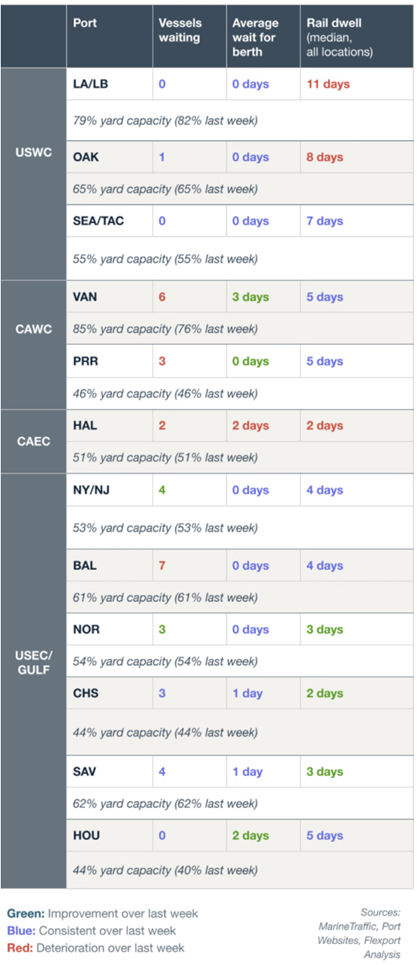
North American Vessel Dwell Times
Port of Los Angeles Sees Record-High September Cargo Volume in 118-Year History… Import Cargo Surges Ahead of Year-End
U.S. container imports in September reached 2.55 million TEU, marking the highest September volume on record. Notably, imports from China to the U.S. increased by 21.2% year-over-year, defying the trade war between the two countries. The Port of Los Angeles surpassed 1 million TEU in monthly throughput, setting a record high in its 118-year history. Detailed figures for the Port of Los Angeles are as follows:
Total cargo volume at the Port of Los Angeles in September: 1,042,652 TEU, up 18.1% year-over-year, marking the highest volume in the port’s history
Imports: 546,696 TEU, +19%. This is the highest monthly figure on record and 26% higher than the average for the past five years
Exports: 125,571 TEU, +10%
Empty containers: 371,206 TEU, up 20.4%, an all-time high
January–September cumulative total: 8,081,625 TEU, up 3.38% year-over-year
Port officials attribute this increase in cargo volume primarily to lower tariff levels compared to last year, robust U.S. consumer spending, and retailers’ demand for year-end merchandise and inventory replenishment. They also note that shipping disruptions surrounding the Suez and Panama Canals have caused some cargo to be rerouted to the U.S. West Coast, particularly the Port of Los Angeles, which has contributed to the volume increase. Among the various records, one notable development is that, following the surge in imports, shipping lines have been returning container equipment to Asia, causing the volume of empty containers shipped out to reach an all-time high. In any case, while a decline in cargo volume had been anticipated as recently as early this year due to concerns over oversupply and a trade slowdown caused by tariffs, the market defied these expectations and staged a turnaround, setting new all-time records. These records demonstrate that U.S. consumer spending and import demand remain robust, while also reaffirming that future changes in tariffs and trade policy will be key variables determining the trends in cargo volume and freight rates.
U.S. Steps Up Crackdown on “Stockpiling Imports” of Solar Products… Import Restrictions Ahead of Section 232 Implementation on December 4
Ahead of the U.S. government’s implementation of Section 232 measures on solar-related products on December 4, authorities are stepping up their crackdown on so-called “stockpiling imports”—efforts to secure inventory before tariffs and minimum import prices (MIPs) take effect. The U.S. Department of Commerce is monitoring import volumes of polysilicon, ingots, wafers, solar cells, and modules to restrict additional imports by existing importers who have increased their volumes abnormally compared to the past. In particular, importers newly registered after August 6, 2026, are limited to importing 55 solar modules per week. This measure is intended to prevent bulk pre-shipments ahead of the application of new “Section 232 tariffs and Minimum Import Prices (MIP)” to relevant products starting December 4. Caution is advised, as the practice of using multiple Importers of Record (IORs)—a method many shippers employ to circumvent import restrictions—could also become an issue. Therefore, companies importing relevant products into the U.S. need to verify the IOR’s import history and clearance eligibility in advance of shipment.
U.S. CBP Tightens Supply Chain Verification… 21% of Fashion Brands Have Experienced Cargo Detention
As U.S. CBP supply chain regulations tighten, importers’ ability to provide proof of origin for raw materials is emerging as a critical customs clearance issue. According to a survey by TrusTrace, a supply chain analytics firm, 21% of fashion brands sold in the U.S. have experienced actual cargo detention by U.S. CBP, and 58% of companies that have not yet experienced this also recognize it as a realistic future risk. Notably, 75% of the surveyed companies are not sufficiently prepared to verify the origin of their raw materials, suggesting that many firms could face serious problems depending on the future direction of CBP investigations. According to the data, the percentage of companies able to secure reliable supply chain data was 75% among Tier 1 finished goods manufacturers, but dropped to 33% for Tier 3 companies and only 20% at the raw material and farm levels. Furthermore, 48% of U.S. retailers do not screen suppliers using the Entity List related to forced labor, and only 21% of companies implement continuous, automated compliance monitoring. Industry experts point out that companies must now do more than simply verify the final country of manufacture—such as “Made in Vietnam” or “Made in China”—but must also, in some cases, be able to trace the supply chain (e.g., Raw Material → Fiber/Yarn → Fabric → Factory → Finished Product) and provide the corresponding documentation.

Update on the Air Freight Market from Asia to the Americas
As the air freight market from Asia enters the year-end peak season, supply shortages and rising freight rates are becoming more pronounced, particularly on routes to the Americas. In China, freight rates from Northern China to the Americas rose 5–10% compared to the previous week as demand for general cargo and e-commerce inventory replenishment ahead of Black Friday and Christmas recovered following the National Day holiday. Rates for shipments to the U.S. from Southern China—including HKG, SZX, and CAN—are also rising as e-commerce volumes have rebounded following the holiday, and securing capacity remains challenging. In Taiwan (TPE), capacity to the U.S. is also scarce, requiring bookings to be made 5–7 days in advance. South Korea (ICN) is showing relatively stable trends; while capacity to the U.S. East Coast is relatively ample due to increased co-loader supply, capacity to LAX remains tight. In Vietnam as well, capacity to the U.S. is severely constrained due to demand for high-tech products and manufacturing components. With AI demand overlapping the seasonal peak in the fourth quarter, capacity is significantly insufficient; therefore, it is necessary to secure capacity earlier than usual and establish shipping plans that account for sufficient lead times.
CBP Postpones Mandatory Electronic Clearance for International Mail by 90 Days… Implementation Set for January 2027
As U.S. Customs and Border Protection (CBP) strengthens clearance procedures by requiring more formalized electronic customs declarations via the Automated Commercial Environment (ACE) for international mail entering the United States, the agency has postponed the implementation date for the new declaration requirement by 90 days, from October 22, 2026, to January 20, 2027. Specifically, the new declaration method, Entry Type 13 (ET13), is an “Informal Entry” process that requires electronic submission of customs clearance information for international mail through ACE. It mandates the submission of shipment-level information—including the tracking number, HTSUS (Harmonized Tariff Schedule of the United States) code, description of goods, country of origin, price, and customs duties—and this requirement has been postponed by 90 days. However, this 90-day extension does not represent a relaxation of regulations; rather, it is a measure intended to provide importers, customs brokers, and freight forwarders with additional time to prepare for the new electronic filing procedure. Companies shipping goods to the U.S. via international mail need to review the changing customs requirements in advance.