
US Logistics Update [Oct 10, 2026]-English

Although household sentiment remains uncertain due to rising prices following the U.S. attack on Iran, the U.S. unemployment rate continues to remain at historically low levels. According to Truist, a major U.S. financial group, the U.S. unemployment rate has remained below 5% for 61 consecutive months—a period approaching the longest streak (64 months) since the mid-1960s (see the graph on the left below). However, the recent pace of job growth appears to be slowing. Nonfarm payrolls in September increased by only 29,000, falling short of market expectations, and as employment figures for the previous several months have also been revised downward, there are some signs that the labor market is cooling. Experts assess the current labor market as being in a “state where both hiring and layoffs are limited.” They analyze that while companies’ demand for new hires is declining, there have been no large-scale layoffs, so overall labor market stability is being maintained. With low unemployment coexisting with a slowdown in employment growth, the market currently estimates the probability of the Fed raising interest rates at less than 20 percent.


Bloomberg reported, citing the DHL Globalization Tracker, that global merchandise trade continues to show strong growth, driven by demand for AI, despite geopolitical headwinds such as Trump’s tariffs and trade wars. According to the DHL index (graph on the upper right), the growth forecast for global merchandise trade this year has been revised upward to 4.6%, surpassing the initial projection of 3.6%. The analysis notes that AI-related goods are driving global trade, with their share of total trade growth surging from 42% last year to nearly 76% in the first quarter of this year. The WTO has also revised its global merchandise trade growth forecast upward, from 1.9% to 3.9% for this year and from 2.9% to 4.1% for next year, driven by a boom in AI-related investment. This marks the fastest growth rate since the 2008 global financial crisis. Meanwhile, while the WTO estimated that nearly half of global merchandise trade growth in the first half of 2026 would stem from AI-related goods, it revised its 2026 services trade growth forecast downward from 4.8% to 3.3% due to factors such as transportation disruptions caused by the war in the Middle East.

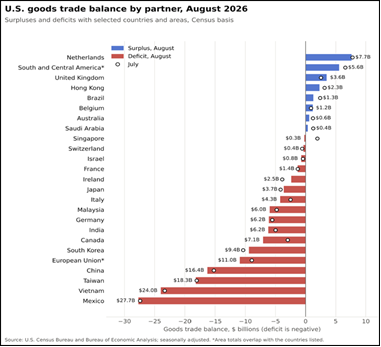
The U.S. Department of Commerce’s Bureau of Economic Analysis (BEA) announced that the U.S. trade deficit in August reached its highest level in 17 months due to a surge in imports, rising 13.7% ($12.7 billion) from the previous month to $105.6 billion. This figure exceeded market expectations of $102.1 billion and marked the largest deficit since March 2025. Total imports rose 4.3% to $420.8 billion, setting a record high, while exports increased by only 1.4% to $315.2 billion, resulting in a significant trade deficit. By product category, imports of capital goods reached a record high of $146.4 billion, up $6.2 billion, driven by the AI investment boom; in particular, semiconductor imports surged by $2.4 billion, the largest monthly increase on record. By country, the largest deficits were with Mexico, Vietnam, Taiwan, and China, in that order, with the deficits with Mexico, Vietnam, and Malaysia reaching record highs. Immediately following the release of these figures, Goldman Sachs revised its forecast for third-quarter U.S. gross domestic product (GDP) growth downward by 0.3 percentage points to 3.1%.
Trump Administration Suspends Microsoft’s Green Card Sponsorship
The Trump administration has suspended the green card application programs of major IT companies, including Microsoft, citing allegations of abuse of the H-1B visa and PERM programs, causing a major uproar. This measure has been extended to other tech companies, such as Adobe and Infosys. On the 8th, Vice President JD Vance criticized the trend, claiming, “Microsoft laid off 6,000 U.S. workers while applying for approximately 6,300 H-1B visas and 3,000 green cards,” and argued that American workers are being replaced by foreign workers. However, this measure does not cancel or suspend the H-1B visa program itself; rather, it halts new and pending PERM labor certification procedures for the targeted companies. Therefore, while there will be no direct changes to existing H-1B status, significant disruptions are expected in the plans of foreign workers who were preparing to obtain permanent residency through employment visas at these companies. In particular, since the path of obtaining a green card through company sponsorship after securing an H-1B job has been one of the primary routes to settlement for international students and foreign professionals in the U.S., if this measure is prolonged or expanded to other companies, it is expected to have a significant impact on the career choices of international students preparing for employment in the U.S. as well as on companies’ recruitment of foreign professionals.

North American Vessel Dwell Times

Rail dwell time refers to the time that rail freight remains at a rail yard after being unloaded from a train or arriving at a terminal until the next step (outbound shipment, truck pickup, connection to another train) actually takes place—in other words, the time the cargo “sits idle” in the rail yard. This year, rail dwell time at the ports of Los Angeles and Long Beach has averaged around 10 days, nearly doubling compared to the previous year. This issue has arisen due to a significant increase in rail usage caused by the sharp rise in trucking rates, and the industry recommends using 40-foot and 40HC containers for urgent shipments. This is because 20-foot containers often require a matching pair (another 20-foot container) on a rail car and must wait until a match is found. In particular, heavy 20-foot containers can cause additional delays while waiting for a lighter partner to balance the axle weight. Meanwhile, U.S. railways transported approximately 8.7 million containers in 2025. According to industry forecasts, this figure is expected to rise to between 10.6 million and 11.1 million by 2030, and could reach as high as 14 million by 2035.
U.S. Import Volume Slows… Entering the Final Stages of a Prolonged Peak Season
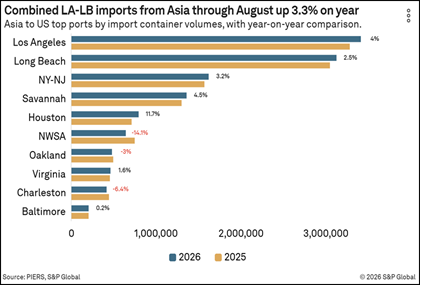
The National Retail Federation (NRF) assessed that the unusually long peak season for ocean freight—which began in May and continued through the summer and early fall—is entering its final stages, and analyzed that August’s import volume, at 2.3 million TEU, is likely to make it the busiest month of the year. Although September was initially expected to be the month with the highest volume, the forecast has been revised downward; specifically, a gradual decline is anticipated to 2.25 million TEU in October, 2 million TEU in November, and 2.02 million TEU in December. However, the NRF notes that while the consumer confidence index is showing weakness, consumer spending remains robust, indicating that import demand is not contracting sharply. Meanwhile, the Ports of Los Angeles and Long Beach—the largest U.S. gateways—have reported that sustained high cargo volumes over the past few months are placing a heavy burden on port operations, particularly due to a shortage of skilled labor. A shortage of crane and top handler operators is causing vessel operations at some terminals to be delayed by one to two shifts, and this impact is spreading to yard operations and drayage. Consequently, truck turnaround time increased from 55 minutes in May to 63 minutes in September, and the proportion of trips taking more than two hours rose from 7% to 11%. Due to factors such as political instability in the Middle East, Panama Canal constraints, and high fuel costs, cargo is concentrating in Southern California, and the high cargo volume is expected to continue at least through the end of October.

IKEA Launches the U.S.'s First Commercial Driverless Freight Operation in Partnership with Kodiak
Furniture retailer IKEA announced that it will partner with autonomous trucking company Kodiak Robotics to launch a driverless freight service in Texas starting later this year. The two companies have been testing autonomous transport for IKEA freight over the past four years, during which time they have completed more than 1,300 shipments and logged over 750,000 miles of autonomous driving. While safety operators have been on board the vehicles until now, the operation is set to expand to a fully unmanned phase. The industry is watching to see if the IKEA initiative will serve as a signal marking the dawn of the commercial autonomous era for long-haul trucking in the U.S. There are high expectations that this will provide a solution to the ongoing truck driver shortage and, in the long term, lead to significant cost savings in U.S. trucking.

CAPE Phase 3 Tariff Refund Process Begins; Scope of Refunds to Be Determined by Additional Court Ruling
The U.S. Customs and Border Protection (CBP) began accepting CAPE Phase 3 refund applications on October 6. This is a follow-up procedure resulting from the court victory of certain importers who challenged the additional tariff measures, enabling those companies to receive refunds for tariffs they had already paid. Currently, the biggest point of contention is the scope of the court ruling’s applicability. The government argues that “only companies that participated in the lawsuit are eligible for refunds”; in this scenario, even companies that paid the same duties would have to file individual lawsuits to receive a refund. However, importers argue that “the ruling’s effect should apply to all companies affected by the same duties,” and if the importers prevail, companies that did not directly participate in the lawsuit could also receive refunds. Depending on the court’s future ruling, the scope of companies eligible for tariff refunds could be limited to “companies participating in the lawsuit” or expanded to “all companies affected by the same tariffs,” making this a matter of intense focus for the import industry.
Global Container Carrier Fleet Capacity Rankings (as of 2026)


Freight Rates Expected to Rise During the Fourth-Quarter Peak Season
According to data from Rotate, an air cargo market analysis firm, air cargo demand in 2026 increased by 8% compared to 2024, driven primarily by AI-related demand. Technology-related cargo—such as servers, semiconductor equipment, and data center components—which is more time-sensitive than general cargo, has been driving demand to the Americas. As a result, the industry is concerned that pressure for freight rate increases will rise significantly as it enters the seasonal peak in the fourth quarter. The fourth quarter is traditionally the peak season for air cargo, with a concentration of e-commerce and IT product shipments ahead of Black Friday and the year-end shopping season—including shipments of Apple’s new products. If this coincides with time-sensitive AI-related demand, supply shortages and upward pressure on freight rates are expected to be greater than ever. Consequently, it appears highly likely that cargo space on key routes and preferred flights for air freight to the U.S. in the fourth quarter will sell out early, and volatility in spot rates will increase significantly.
