
US Logistics Update [May 9, 2026]-English

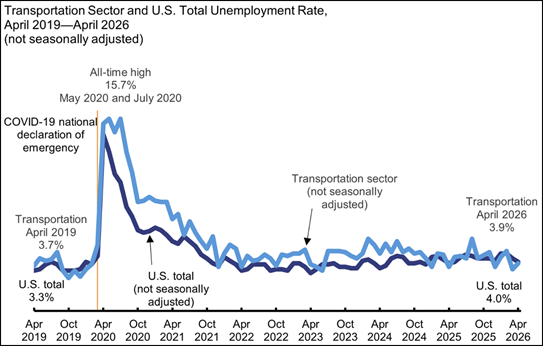
The U.S. Bureau of Labor Statistics announced on the 8th that nonfarm payrolls in the U.S. increased by 115,000 in April compared to the previous month, while the unemployment rate remained unchanged at 4.3%. Although many experts had expressed concern that the sharp rise in energy prices caused by the war in Iran could trigger increased layoffs alongside a decline in household spending power, the impact of the war on the job market appears to have been limited. By sector, the healthcare sector led the employment growth in April with an increase of 37,000 jobs, while the retail trade (22,000) and social assistance (17,000) sectors also contributed to the job gains. In particular, the cyclically sensitive transportation and warehousing sector also saw an increase of 30,000 jobs, contributing significantly to employment growth, and the unemployment rate in the transportation sector fell below the overall unemployment rate, indicating a tightening labor market (see graph on the right below). The labor force participation rate fell slightly to 61.8% from 61.9% the previous month, while the wage growth rate rose 0.2% month-over-month, falling short of market expectations (0.3%), and increased 3.6% year-over-year, also missing market forecasts (3.8%). Despite easing concerns over a slowdown in employment, fears of rising inflation due to the shock of high oil prices are expected to persist as the Iran conflict enters its third month. Consequently, the market is increasingly weighing the possibility that the U.S. Federal Reserve (Fed) will not cut interest rates this year. According to the CME Group’s Fed Watch, the interest rate futures market reflected a 73% probability that the Fed would keep the benchmark interest rate at the current 3.50–3.75% range through December, immediately following the release of the employment data.

On the 7th, the U.S. Court of International Trade (CIT) ruled, by a 2-1 majority, that the 10% tariff imposed by the Trump administration on all imports under Section 122 of the Trade Act was unlawful. Since taking office, President Trump has actively utilized tariff policies to address the trade deficit, revive domestic manufacturing, and pressure other countries. However, the court ruled that Section 122 of the Trade Act was not designed to serve as a legal basis for resolving the U.S. trade deficit and ordered the suspension of the tariffs. President Trump blamed the ruling on “two radical left-wing judges” and immediately filed an appeal on the 8th.
Meanwhile, according to a CBP update filed with the U.S. Court of International Trade (CIT) on April 28, approximately 21% of all entries have been submitted through the CAPE system for IEEPA duty refunds, and of these, about 3% have completed liquidation through CAPE and entered the refund stage. Refunds are scheduled to be paid via ACH Direct Deposit to the Importer of Record or the designated Notify Party, and the first IEEPA duty refunds are expected to be processed around May 11. CBP has indicated that for existing unliquidated entries or entries within 80 days of liquidation, refunds will be available approximately 60 to 90 days after CAPE submission. However, for entries in Suspended, Extended, or Under Review status, or for Warehouse Entries, the refund process will proceed only after the entry has been liquidated. Based on the initial results of CAPE operations, as of April 26, only 63% of CAPE declarations passed the Initial File Validation during the first week of filing. Of the 13.3 million entries included in declarations that passed validation, approximately 2.1 million—or about 16%—were rejected during the Entry-specific Validation stage. Consequently, importers need to review their entry data in advance before applying for a CAPE refund. For rejected entries, importers must promptly consider whether to file a protest or submit a Post Summary Correction (PSC) to maintain refund eligibility and prevent delays. Additionally, even if an entry is already included in a CAPE Declaration, there is a possibility that CBP may reject it or raise issues during the review process; therefore, importers must continue to monitor the protest deadline. In particular, CBP has not yet issued specific guidelines regarding entries for which more than 80 days have passed since liquidation but which are still within the 180-day protest period; these entries are expected to be addressed in a subsequent phase of CAPE.

TPEB (Trans-Pacific Eastbound) Market Trends
In addition to the typical increase in demand during the May holiday season, the TPEB market is seeing a gradual tightening of capacity as blank sailings are scheduled for Weeks 20 and 21. In particular, with the implementation of new long-term contracts and a reduction in some sailings, the allocation of Named Account Contract (NAC) capacity is being managed on a limited basis. Consequently, urgent cargo and FAK shipments require early booking, and the industry expects this situation to persist for the next few weeks. While freight rates have remained generally stable as of early May, some carriers are pushing for slight increases; given the tightening capacity, rates are likely to rise somewhat by late May. Additionally, the Emergency Bunker Surcharge (EBS) remains in effect, and while the Peak Season Surcharge (PSS) was scheduled to take effect in late May, some carriers are delaying its implementation, making it highly likely that the full imposition of the PSS will be postponed until June. Consequently, starting in mid-May, securing cargo space and schedule stability are expected to emerge as more critical factors in the TPEB market than freight rates themselves.
North American Vessel Dwell Times

North American Freight Car Shortage Worsens… Logistics Bottlenecks Widen Amid Surging Energy Demand
The JOC reports that the freight car shortage in the North American rail market is worsening, leading to increased disruptions in project cargo transportation and rising costs. Recent expansion of AI data centers and increased investment in power infrastructure have led to a surge in demand for transporting large energy equipment such as transformers and turbines, significantly increasing pressure on rail capacity. However, the current North American railcar fleet stands at 1.66 million units, representing a net decrease of 24,149 units (1%) from 2019 to 2025. Furthermore, actual availability is even lower due to the increasing number of aging cars. In particular, while project cargo transportation relies heavily on rail, the lead time for securing railcars has increased from a matter of weeks to several months, sharply increasing the risk of delivery delays. The situation for ultra-heavy cargo transportation is worsening, as the supply of railcars for large cargo weighing over 600,000 pounds (27 tons) and special railcars with 16 or more axles is reportedly extremely limited. This supply shortage is also affecting port operations, with cargo remaining in ports for extended periods due to delays in rail connections. Consequently, additional costs are being incurred, such as increased demurrage charges and double-handling fees. Since new railcar production involves high costs and long lead times, it is difficult to improve supply in the short term; the industry forecasts that the supply-demand imbalance is likely to worsen further for the foreseeable future.
FourKites Launches Ocean Booking Automation Tool… Moves to Reduce Reliance on Forwarders
FourKites, a leading provider of real-time shipping visibility alongside Project44, has unveiled “Booking Connect for Ocean,” a new solution that automates ocean container bookings. The company emphasized that this launch marks “a turning point that fundamentally improves the inefficient structure where shippers have traditionally relied on emails and phone calls between forwarders and carriers.” According to FourKites, traditional ocean bookings were prone to frequent errors and delays due to manual information exchange among multiple parties across different regions and time zones. However, the new solution is designed to have a single digital agent automatically handle the entire process—from booking request to confirmation to shipment creation—resulting in a dramatic reduction in errors and delays. FourKites noted that this feature is not merely a UI improvement but a “results-driven automation engine,” adding that shippers can still opt to have forwarders handle bookings on their behalf as before, so the structure does not completely exclude forwarders. However, the industry assesses that, similar to European visibility provider Shippeo’s acquisition of Logward, the trend of FourKites evolving beyond a visibility platform to become a company that actually executes logistics—like Flexport—has now gained full momentum.
U.S. Department of Transportation Fully Transitions to ‘Motus’ Registration System for Truckers and Brokers… Strengthens Measures to Block Fraud and Ghost Companies
The U.S. Department of Transportation (DOT) has officially announced the introduction of “Motus,” a new registration system for trucking companies, freight brokers, and freight forwarders. The DOT announced that the existing registration system will be discontinued as of May 14 and that all companies must update their information by the deadline. The core of the new system is a two-factor authentication process that combines personal identity (IDEMIA) with corporate information (CLEAR). The goal is to identify so-called “chameleon carriers”—companies that re-register under a new name after going out of business—and significantly curb broker fraud and the registration of ghost companies. Users must first verify their personal identity via a QR code and then pass a verification process that cross-checks corporate information—such as company name, EIN, and address—before gaining access to the system. This is expected to enhance transparency and trust across the industry. However, it is also expected to serve as a clear warning sign of a looming decline in the number of truck drivers in the U.S.
U.S. ‘Roadcheck’ Enforcement Week Expected to Tighten Trucking Supply and Push Freight Rates Higher
The annual “International Roadcheck” safety enforcement campaign for heavy-duty trucks, conducted across the United States, is expected to cause a short-term supply crunch and rising freight rates in the trucking market again this year. During Roadcheck, state police and federal authorities conduct intensive inspections of vehicles, documentation, and driver compliance. As a result, some trucks are placed out of service. The industry notes that this period has historically been marked by a recurring pattern of reduced truck availability and temporary spikes in spot rates. In particular, analysts predict that short-term supply pressures will be more pronounced this year. Despite existing excess supply in the market due to the economic slowdown, the number of drivers reducing their hours or taking time off to avoid enforcement is expected to rise. Experts note, “While Roadcheck is an annual event, its impact is more pronounced when the market is weak,” adding, “Spot rates could see a noticeable rebound in some regions.”

Air Freight to the U.S. Continues to Rise Despite Weak Demand from Asia Due to Cost Pressures
According to the latest data released by WorldACD on the 9th, air freight volumes from the Asia-Pacific region to the U.S. decreased by 4% week-over-week as of late April to early May. While major exporting countries such as Japan, Vietnam, and Indonesia saw double-digit declines, shipments from South Korea increased by 10%, showing a relatively robust trend. In the Middle East and South Asia (MESA) region, shipments to the U.S. also decreased by 2% compared to the previous week. However, air freight rates continue to rise, with rates from Asia to the U.S. increasing by 1% week-over-week. Global average freight rates are also continuing to rise, remaining in the mid-3-dollar range per kilogram. Analysts attribute this “demand-rate disconnect” to airlines’ supply adjustments and rising costs. As jet fuel prices have surged, some airlines have scaled back unprofitable routes, leading to a decrease in overall cargo supply. Consequently, supply in the market remains limited, sustaining upward pressure on freight rates. Furthermore, as high freight rates persist, some Asian shippers are shifting their logistics to Europe via Sea-Air transport routes that transit through the U.S. West Coast. The industry believes there is a high likelihood that air freight rates will remain at elevated levels for the time being, and forecasts that market volatility will intensify further due to the combined effects of rising fuel costs and geopolitical risks.

Amazon Opens Its Logistics Infrastructure to the Public… Signaling a Major Shift in the Global Logistics Market
On the 4th, Amazon officially launched “Amazon Supply Chain Services” and announced that it would make the logistics infrastructure that has supported its e-commerce operations available to all businesses, signaling a structural shift across the global logistics industry. This service is designed to allow companies to manage the entire supply chain—including sea, air, land, and rail transportation; inventory storage; order processing; as well as customs clearance, booking, tracking, and last-mile delivery—all on a single platform. It is drawing particular attention from the industry because it is available even to companies that are not listed on the Amazon Marketplace. Major global shippers such as P&G, 3M, American Eagle, and Lands’ End have already adopted some of these features. The market views this move as an “AWS strategy for the logistics industry,” interpreting it as an application of the model that propelled AWS’s growth—where Amazon opened its proprietary IT infrastructure to external users—to the logistics sector. If Amazon can simultaneously deliver cost efficiency, delivery speed, and operational stability based on its massive transportation assets (trailers, containers, aircraft) accumulated over decades, along with its advanced demand forecasting and data analysis capabilities, the global logistics market is expected to shift from its current structure centered on multiple operators to a platform-based integrated model. In this scenario, a seismic shift is anticipated in the roles and competitive landscape of traditional forwarding and 3PL companies. However, some observers downplay the significance of Amazon’s ASCS, arguing that it is not a new concept and that even if Amazon enters the market, its services will be limited to domestic logistics.