
US Logistics Update [Mar 28, 2026]-English

The British current affairs weekly The Economist forecasts that even if the war in Iran were to end immediately, it would take more than four months for the global oil and gas market to return to normal. The analysis suggests that due to the aftermath of supply-demand imbalances, global crude oil inventories are likely to continue declining for several weeks even after the Strait of Hormuz reopens, and prices could surge further as hoarding continues to secure scarce energy supplies. Daily crude oil production in Gulf countries has currently been reduced to 40% of pre-war levels, and it is estimated that it will take at least two to four weeks to restore production to pre-war levels. In particular, the supply shortage for LNG is expected to be even more severe, as the Ras Laffan industrial complex in Qatar—a key LNG production hub—was hit by missile attacks, damaging 17% of its facilities. Qatar estimates that it will take up to five years to restore the affected facilities.

OECD Forecasts “U.S. Inflation to Rise 4.2% This Year Due to War”
As the conflict in the Middle East fuels inflation fears, the OECD has significantly revised upward its inflation forecasts for major economies. In particular, it projects that U.S. inflation will rise to 4.2% this year, with inflation rates across the G20 expected to reach 4% (see graph above). It also warns that if exports from Middle Eastern countries are disrupted, this poses a significant downside risk that could further fuel inflation, lower growth rates, and cause volatility in financial markets. Meanwhile, economists predict that rising diesel prices caused by the war in Iran will ultimately lead to higher product prices for companies, potentially pushing inflation back up to the mid-3% range in April or May. Consequently, opinions are emerging that the Federal Reserve (Fed) should raise interest rates rather than cut them.
Key Guide to Tariff Refunds
Refunds are processed exclusively through U.S. Customs and Border Protection (CBP)’s Automated Commercial Environment (ACE) system, and no checks are issued. Importers who have not yet registered for the electronic refund system must do so immediately. Currently, only about 5,000 companies out of approximately 300,000 eligible businesses have registered. Furthermore, a significant number of companies are filing lawsuits for duty refunds, as there is a possibility that the Trump administration may only grant refunds to those who have filed lawsuits. However, experts advise that unless there is an urgent need for cash, it is acceptable to wait for the court’s final decision. This is because the statute of limitations for filing a lawsuit extends until February 2027, which is ample time. Additionally, refunds accrue approximately 6% interest; rushing to file a refund claim could actually shorten the interest calculation period, so caution is advised. Meanwhile, the 10% Section 122 (Balance of Payments Authority) tariffs currently imposed by the Trump administration are set to expire at the end of July, and it is understood that many companies are considering front-loading shipments. This is because reciprocal tariffs in most countries were higher than the existing Section 122 tariffs, so companies are looking to import goods before tariffs imposed under Section 301 take effect.

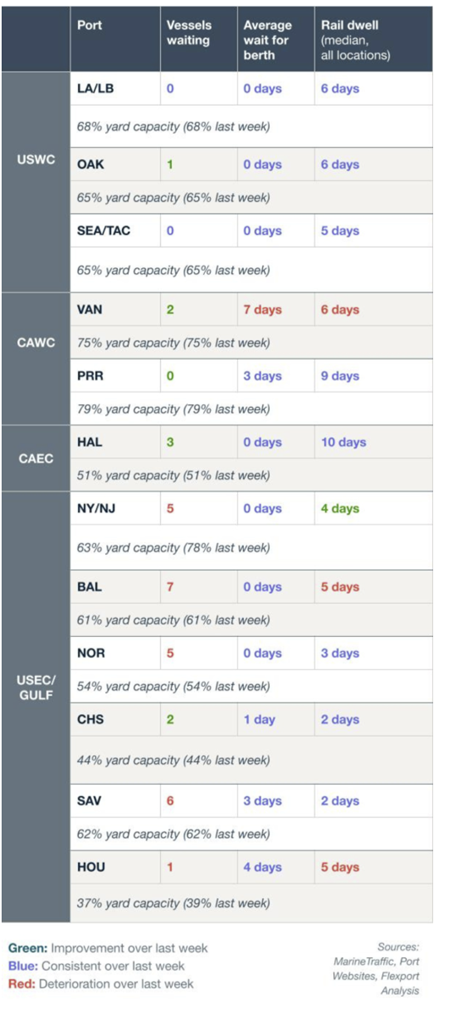
North American Vessel Dwell Times
Summary of TPEB Market Trends
First, regarding supply, based on scheduled sailings for April, an increase in blank sailings by carriers is expected to cause supply disruptions affecting approximately 6–10% of the overall schedule. However, the actual perceived supply shortage is even more severe. Additionally, concerns have been raised that if vessels on certain routes are forced to reroute via the Cape of Good Hope due to the conflict in the Middle East, this could lead to further equipment shortages and congestion at major Asian hubs. Regarding freight rates, carriers have already implemented General Rate Increases (GRIs) for the remainder of March and have announced additional GRIs effective April 1. Furthermore, in response to the sharp rise in bunker prices, they have introduced an Emergency Fuel Surcharge (EFS) and are also imposing an Inland Fuel Surcharge (IFS) to reflect rising diesel costs in intermodal segments such as rail and inland transport. Meanwhile, the Peak Season Surcharge (PSS), which is typically applied to meet peak season demand, is expected to be postponed until the end of April, given that the EFS and IFS will be implemented first in April. In any case, April is a period marked not only by freight rate increases but also by supply contraction, equipment shortages, hub congestion, and rising fuel surcharges.
Middle East Update
On Friday, March 27, the ultra-large container ships CSCL Indian Ocean and CSCL Arctic Ocean, operated by China’s COSCO, attempted to enter the Strait of Hormuz but abandoned their course midway and turned back. This is notable as the first instance of a major global shipping company attempting to transit the strait since the conflict began. However, it suggests that risks in the Strait of Hormuz remain at an uncontrollable level. The timing for shipping lines to resume operations through the Strait remains unclear. However, COSCO announced on March 25 that it would resume bookings on the Asia–Gulf route. Meanwhile, as global major carriers have scaled back or suspended operations due to escalating tensions in the Middle East, regional carriers are rapidly filling the void and expanding their services. Leveraging their strengths of short lead times and flexible schedule adjustments, these regional carriers are increasing the deployment of new services, primarily on the Gulf–India–East Africa route. However, while capacity has increased, insurance and security risks remain high, and actual lead time volatility remains significant due to port congestion and stricter inspections.
U.S. Trucking Rates Continue to Soar
Land truck freight rates continue to soar as supply tightens due to stricter regulations on non-domiciled commercial drivers and more rigorous English proficiency tests, while diesel prices have skyrocketed in the wake of the Iran conflict, reaching their highest levels since late 2022. According to DAT Freight & Analytics, spot truck rates have risen 15–20% year-over-year despite high interest rates, a sluggish housing market, and weak freight demand (see graph below). In fact, truck brokers and asset-based truckload carriers have recently been refusing to haul freight or demanding renegotiation of contract rates. Additionally, the tender rejection rate—which typically remains below 5%—has surged to 14–15% recently. Meanwhile, the supply of trucks could tighten further due to new federal regulations. Following the Federal Motor Carrier Safety Administration (FMCSA)’s formal implementation earlier this week of regulations restricting non-resident commercial driver’s licenses (CDLs), the U.S. House of Representatives is set to introduce is set to introduce “Delilah’s Law,” a bill that would retroactively invalidate certain non-resident CDLs, thereby eliminating the need for non-resident CDL holders to wait until they can apply for renewal with state licensing agencies. Despite rising freight rates, carriers are taking a cautious approach to expanding supply, which is also constraining supply growth. Rising fuel costs are putting pressure on owner-operators and small carriers, who find it difficult to pass on these costs, potentially leading to further supply shortages. Meanwhile, in the contract market, large trucking companies are passing on high fuel costs to shippers through fuel surcharges. As a result, shippers whose transportation budgets have been exceeded are considering cheaper alternatives, such as intermodal rail transport. However, satisfaction with intermodal services is below 50%, making service improvement a key priority.

Trends in U.S. Nuclear Power Projects
The United States is simultaneously pursuing Small Modular Reactors (SMRs), capacity upgrades for existing nuclear power plants, and the restart of idled reactors. The federal government aims to increase the current generating capacity of 100 GW to 400 GW by 2050 and is pushing to construct 10 large-scale nuclear reactors by 2030. Nuclear power development is rapidly accelerating due to the recent expansion of approvals and investments in new projects centered on next-generation SMRs. Major projects have been announced in succession, including a $40 billion SMR construction partnership between the U.S. and Japan, and the approval for the construction of the first commercial SMR in the U.S. by TerraPower, backed by Bill Gates. This structure generates a continuous demand for heavy-lift cargo, including medium- and large-sized modules, pressure vessels, heat exchangers, turbines, cooling systems, and special steel structures. Since SMRs involve manufacturing modules in factories and transporting them to the site—a process that spans factory → port → inland transport (trailer/rail) → site delivery—project cargo transportation is essential throughout the entire route.

Middle East Update
A complete flight ban remains in effect over the airspace of Iran, Israel, Iraq, Kuwait, Bahrain, and the Dammam region of Saudi Arabia. The UAE (Dubai and Abu Dhabi) and Qatar (Doha) have partially reopened their airspace or resumed commercial flights under restricted conditions, but operations are being conducted under continuous security monitoring. Emirates (approx. 65%), Etihad (approx. 15%), and Qatar Airways (approx. 15%) have resumed limited operations, but major EU and U.S. airlines (Lufthansa, Cargolux, United, Air France-KLM, etc.) have suspended all cargo transport to the region (embargo) until March 28. With the closure of Middle Eastern airspace blocking existing transshipment routes (Dubai, Doha, Riyadh, etc.), supply has become severely constrained, causing freight rates on the China–Europe route to surge by 25% and those on the Southeast Asia–Europe route to rise by 17%. Rates on the China–U.S. route also rose by 9%, maintaining an overall upward trend. However, fuel costs are rising even more sharply than freight rates (more than double pre-war levels), and airlines are increasingly passing on these costs by adjusting fuel surcharges every two weeks.
USPS Introduces Fuel Surcharge for the First Time
The USPS (U.S. Postal Service) announced that it will impose an 8% fuel surcharge on all package shipping rates starting in April. This marks the first time the USPS has introduced a separate surcharge citing fuel costs. While the USPS stated that this measure is a short-term response, there are predictions that it could affect the overall logistics cost structure in the future. The imposition of the fuel surcharge follows a sharp rise in diesel prices in the U.S. due to the recent U.S.-Iran conflict. Diesel prices in the U.S. currently stand at $5.38 per gallon (approximately 3.79 liters), a rise of more than 50% from the previous year. Gasoline prices are also approaching an average of $4 per gallon, a surge of over 30% compared to pre-war levels. Meanwhile, U.S. private delivery companies such as FedEx and UPS are already imposing fuel surcharges and have recently raised their rates further to reflect the sharp rise in oil prices.
Jeff Bezos is pushing for a $100 billion fund to rebuild manufacturing and supply chain companies using AI
The goal is to acquire traditional manufacturing and industrial companies and use AI to advance all aspects of production, design, and supply chain operations. Target industries include semiconductors, defense, and aerospace—sectors where efficiency improvements can have a significant impact. Bezos’s manufacturing AI project can be interpreted not merely as an investment but as an industrial expansion of Amazon’s operational model. It is expected to have far-reaching effects across the board, from shortening manufacturing lead times to changing inventory strategies and impacting last-mile logistics.