
US Logistics Update [Jun 6, 2026]-English

During a meeting with Wisconsin agricultural leaders on the 5th, President Trump stated, “We are at the point where we will be pulling out of Iran very soon,” adding, “A very hardline approach might be the easier way, but we will pull out, and when we do, fertilizer prices will drop significantly, and oil and gas prices will all drop significantly.” This has greatly increased the likelihood of an end to the war in Iran. President Trump’s remarks suggest that an agreement will be reached soon or that military attacks may resume, but they imply that an end to the war is imminent in one form or another. Currently, the U.S. has reached a broad agreement with Iran to open the Strait of Hormuz upon the end of the war and to engage in nuclear negotiations for the next 60 days, but the two sides have yet to reach an agreement on the timing of the release of Iran’s frozen assets. Meanwhile, on the 3rd, the U.S. House of Representatives passed a resolution in a plenary session to limit President Trump’s authority to wage war against Iran by a vote of 215 to 208, thereby blocking the possibility of further attacks by President Trump. Although the resolution is unlikely to have legal effect due to numerous obstacles—including President Trump’s potential veto, the requirement for a two-thirds majority to override it, and Senate approval—it is considered significant due to the defection of Republican lawmakers and is deemed sufficient to exert pressure on President Trump.


On the 5th, the U.S. Bureau of Labor Statistics announced that nonfarm payrolls in the U.S. increased by 72,000 in May compared to the previous month, while the unemployment rate remained at 4.3%, the same level as a month ago. This positive employment outlook contrasts with concerns that the sharp rise in oil prices caused by the war in Iran, coupled with a decline in household spending power, could trigger an increase in layoffs and lead to an economic slowdown. As the U.S. economy demonstrates resilience, the market is increasingly weighing the likelihood that the Federal Reserve (Fed), led by new Chair Kevin Warsh, will not proceed with interest rate cuts. With market attention focused more on inflation than employment, the U.S. Personal Consumption Expenditures (PCE) price index—which the Fed uses as a benchmark for monetary policy—rose 3.8% year-over-year in April, marking the largest increase in about three years and significantly exceeding the Fed’s 2% inflation target. On Friday, the 5th, the CME Group’s FedWatch tool indicated a 58% probability that the Fed will raise the benchmark interest rate by at least 0.25 percentage points at least once by December. The bond market is also focusing on the risk of rising inflation and reflecting the possibility of a Fed rate hike, with yields on 10-year and 30-year U.S. Treasuries breaking through the psychological resistance levels of 4.5% and 5.0%, respectively.
U.S. Announces Plans to Impose 10–12.5% Tariffs on 60 Countries Citing 'Forced Labor'
The U.S. has announced plans to impose new tariffs on countries worldwide under the pretext of combating forced labor, signaling a major shift in the global trade landscape. The Trump administration is moving forward with a plan to impose tariffs of 10% on major allies such as the European Union (EU) and Canada, and up to 12.5% on other countries, including South Korea and Japan, based on Section 301 of the Trade Act. The U.S. Trade Representative (USTR) stated that a total of 59 countries and EU member states are failing to adequately control the distribution of products linked to forced labor, and announced plans to implement retaliatory tariffs starting in late summer. Unlike the national security-based tariffs (Section 232 of the Trade Expansion Act) previously applied to steel and aluminum, this measure is expected to have a broader impact as it can be applied broadly on a country-by-country basis rather than targeting specific products. The market is concerned that another tariff storm may be brewing, with some even raising the possibility of these tariffs being applied in conjunction with existing ones.

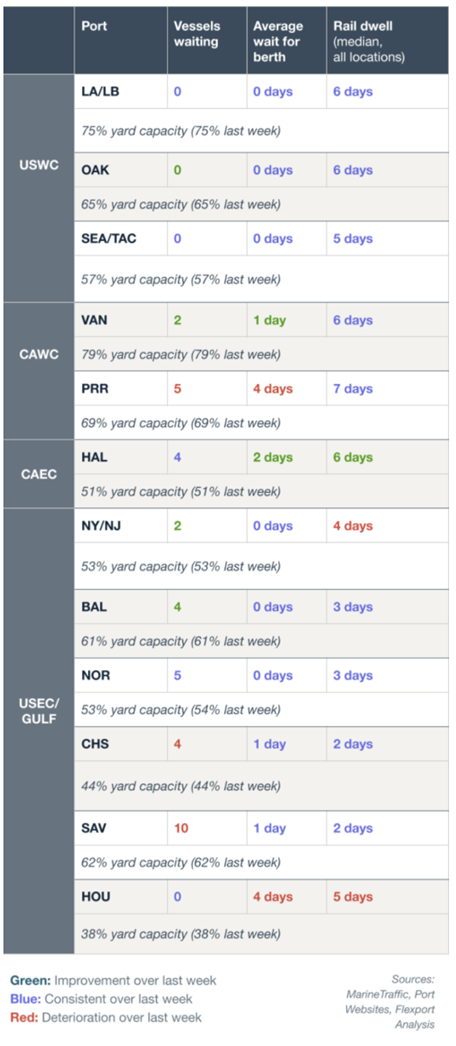
North American Vessel Dwell Times
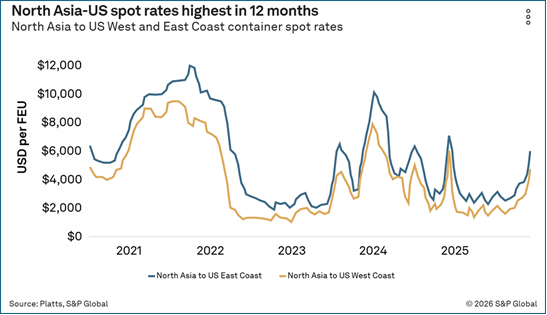
Container Freight Rates Hit Two-Year High… Early Peak Season and Port Congestion Create a “Perfect Storm”
A combination of factors—including congestion at Chinese and German ports, delays at the Panama Canal, the closure of the Red Sea, and rerouting around Africa—has absorbed a massive amount of shipping capacity, signaling a structural shortage in the global shipping market. Meanwhile, an earlier-than-expected peak season has begun on Asia–U.S. and Asia–Europe routes, driving container rates to their steepest rise in two years. S&P Global’s Platts Global Container Index has surged 70% from May to $4,662 per FEU, while the Drewry Index has also risen 26%. Spot rates on the U.S. West Coast have risen to $4,700 (+20%), while those on the East Coast have climbed to $6,000 (+19%). Experts predict that “the supply-demand imbalance is not a short-term phenomenon but is leading to structural changes” and that “shipping companies will secure significant profits during this upward trend.”
U.S. Significantly Tightens Crackdown on Small and Overseas-Based Importers… Sharp Rise in Customs Detentions
On June 3, President Trump issued an executive order announcing measures to strengthen Importer of Record (IOR) requirements and significantly enhance supply chain transparency and the penalty system. The industry reports that customs detentions are already on the rise, particularly for shipments from China and Vietnam, and that the intensified AI-based risk screening by customs authorities is becoming increasingly evident. The key provisions of this executive order include: △strengthening verification of the importer’s identity △raising bond requirements △mandating proof of domestic assets and business operations. In particular, it designates irregular, small-scale, and overseas-based IORs as major risks and expands restrictions on “informal entry,” which had previously been subject to relatively lax regulations. Under the new regulations, IORs must provide CBP with proof of beneficial ownership information, accurate product specifications, consistency between country of origin and documentation, and the completeness of documents submitted within 90 days. The industry anticipates that the screening burden on forwarders, brokers, and 3PL companies will increase significantly as overseas seller-centric practices—such as low-value declarations using DDP structures and circumvention of country-of-origin rules—become targets of enforcement. Meanwhile, experts point out that with the expansion of AI-based analysis, patterns of value manipulation, country-of-origin changes, and IOR changes are coming under intense scrutiny. Experts predict that “an increase in customs detentions is likely to lead to higher container yard (CY) storage fees and demurrage and detention (D&D) costs,” suggesting that a reevaluation of the Foreign IOR structure is necessary.
Texas Ports Experience ‘Boom’ Amid AI Boom… Data Center Imports Exceed $107.7 Billion
Driven by the rapid growth of the artificial intelligence (AI) industry, imports of data center-related equipment through Texas ports reached $107.7 billion in 2025, recording a high average annual growth rate of 19.5% over the past five years, according to a report by Supplychain24/7. This indicates that Texas is rapidly emerging as a global logistics hub. In particular, a surge in large-scale project cargo—including not only servers and network equipment but also power infrastructure such as turbines and transformers—is creating a ripple effect across related industries, including logistics, manufacturing, and warehousing. Laredo, Texas, has emerged as the largest border gateway for AI and data center equipment, and in response, rail and transportation infrastructure is rapidly expanding. The Port of Houston is also emerging as a key hub; recently, six large turbines required for a data center project were imported through the port, and more than 400 specialized trucks were mobilized to transport them to their final destinations, indicating growing logistics demand for mega-projects. This trend is also having a significant impact on the industrial real estate market, with industrial lease space in Texas more than doubling compared to five years ago. An industry insider noted that AI infrastructure investment is linking ports, railways, warehouses, and manufacturing to form a new “logistics super cycle,” stating, “Data centers are no longer simply IT facilities but a core pillar forming a large-scale industrial ecosystem,” and adding, “Texas, in particular, is establishing itself as the hub of North America’s supply chain restructuring.”
FedEx Freight: “Autonomous Truck Technology Is Already Ready”
The industry is paying close attention after John A. Smith, CEO of FedEx Freight—North America’s largest freight carrier—stated that technology for large autonomous trucks is already ready. CEO Smith noted that current trucks are capable of driving 99.9% of the journey—from leaving the depot to traveling on the highway to the next destination—without driver intervention. He added that the timing of autonomous trucks hitting actual roads depends solely on government approval, and that “regulation” will be the biggest hurdle moving forward.

Amazon to Hold ‘Prime Day’ for Four Days Starting June 23
Amazon’s annual large-scale discount event, “Prime Day,” is scheduled to take place over four days from June 23 to 26, and air cargo volumes are expected to increase while freight rates remain high for the time being.
Hidden Costs Threaten Growth of Cross-Border E-Commerce as Consumers Abandon Purchases
Despite the continued growth of the international online shopping market, hidden costs such as duties and taxes, along with shipping and return-related challenges, remain major barriers preventing consumers from completing cross-border purchases, according to a recent report released by market research firm Landmark Global. According to the firm’s survey, 43% of respondents in North America—including consumers in the U.S. and Canada—reported having abandoned a purchase due to unexpected customs duties and taxes when shopping overseas. In Canada specifically, 59% of respondents cited these hidden costs as a major obstacle, indicating a higher level of concern. U.S. consumers were more sensitive to shipping issues, with 38% of respondents citing delivery delays as their biggest concern. Approximately two-thirds expected overseas orders to arrive within two weeks, and among them, 21% wanted delivery within one week, indicating that overseas direct purchases now require service levels comparable to domestic e-commerce. Price transparency is identified as a key factor in resolving these issues. Approximately 70% of all respondents stated that they would be more likely to complete a purchase if customs duties and taxes were included upfront at the checkout stage. Among Canadian consumers, this figure rose to 73%, indicating that the upfront disclosure of costs has a direct impact on sales growth. Return procedures also play a significant role in consumers’ purchasing decisions. Forty-one percent of consumers stated they would be more likely to consider overseas purchases if returns were possible locally, while 24% cited the complexity of the return process itself as a problem. Experts predict that as the global e-commerce market enters a growth phase, providing a “trust-based shopping experience” will become a key competitive advantage, going beyond simply acquiring customers. In particular, they forecast that ensuring price transparency, reliable delivery, and establishing a simple returns system will determine future business performance.