
US Logistics Update [Jun 27, 2026]-English

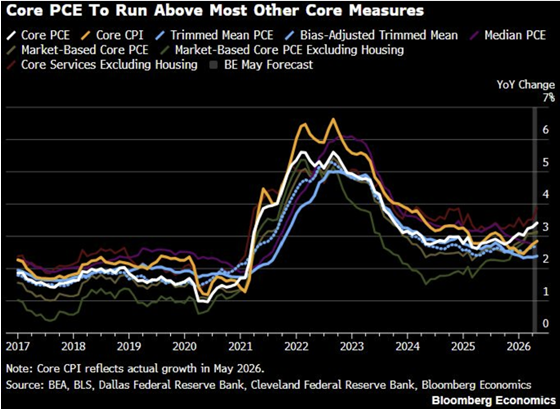
The U.S. Department of Commerce announced on the 25th that the May Personal Consumption Expenditures (PCE) price index rose 4.1% year-over-year. Amid lingering repercussions from high oil prices triggered by the war in Iran, the index hit its highest level in over three years, since April 2023. The PCE, which had remained in the 2% range through February of this year, rose to the 3% range after the war broke out and then climbed to the 4% range in May. Following last week’s announcement that the May Consumer Price Index (CPI) rose to 4%—its highest level in over three years—the sharp rise in the PCE is signaling a spread of inflation, drawing intense attention to the Federal Reserve’s (Fed) response. Accordingly, the CME Group’s Fed Watch tool projects a 30% probability of a rate hike in July, 65% in September, 73% in October, and 82% in December. However, many experts expect future inflation indicators to stabilize as international oil prices—the primary driver of inflationary pressure—are falling rapidly amid expectations of a normalization of the Strait of Hormuz. Meanwhile, the national average price of gasoline in the U.S. remains at $3.93 per gallon—still about $1 higher than before the war—and the AI data center boom is also fueling inflation. U.S. consumers, who had hoped that a de-escalation of the Iran conflict would lead to lower oil prices and stabilize inflation, are now bearing the burden of rising costs—from smartphones to electricity bills—due to surging demand for chips and energy.
According to the “Semiannual Economic Outlook” for the first half of 2026, released by the Institute for Supply Management (ISM) and based on a survey of purchasing and supply chain managers in the U.S. manufacturing and non-manufacturing sectors, both manufacturing and services are expected to maintain a clear expansionary trend this year, raising expectations for the U.S. economy in the second half of the year. First, in the manufacturing sector, revenue is projected to increase by 8.4% in 2026—significantly exceeding last year’s forecast of 4.4% growth—with 82% of respondents anticipating revenue growth. The ISM expects revenue to expand in 14 out of 18 manufacturing sectors. Furthermore, capital expenditures (CapEx) are projected to rise by 4.9%, production capacity is expected to expand by 9.7%, and the capacity utilization rate is forecast to improve to 89.6%. Manufacturing prices rose by 11.9% in the first half of the year, and a 14.1% increase is projected for 2026 as a whole, suggesting that inflationary pressures will persist. Employment is expected to increase by 1.4%. In the service sector, revenue is projected to rise by 8.6% in 2026, with capital expenditures increasing by 6.4%, production capacity expanding by 7.1%, and the capacity utilization rate reaching 91.3%—a higher level than in the manufacturing sector. In addition, service prices rose 7.7% in the first half of the year, and are projected to rise 8.9% for 2026 as a whole. In contrast, employment is expected to see only a modest increase of 0.9%. The ISM stated, “Both the manufacturing and service sectors are expected to maintain an overall growth trend this year,” noting that key indicators such as inflation, investment, and capacity utilization are generally trending upward compared to last year.

North American Vessel Dwell Times

Strait of Hormuz Reopens, but… Freight Rates Soar and Supply Shortages Expected to ‘Last at Least Several Months’
Although the Strait of Hormuz has reopened following a preliminary agreement between the U.S. and Iran, most industry experts predict that disruptions to global supply chains will continue for the time being, suggesting that current high freight rates and supply shortages are likely to persist. Industry experts cautioned against expecting an early return to stability, stating, “The resumption of shipping is merely the starting point of recovery; it will take considerable time to return to normal.” Experts point to the severe imbalance in vessel and container positions as the biggest obstacle to normalization. They analyze that vessel locations and equipment deployment have been disrupted due to months of using detour routes, and that it will take at least 4 to 6 weeks just to normalize this situation. Furthermore, with port congestion and delayed arrival and departure schedules compounding the issue, additional time will be needed for route recovery. Consequently, volatility in the freight rate market is expected to persist for the time being. In other words, the aftermath of the container capacity shortage and the sharp spike in spot rates caused by detour routes remains, and it is assessed that freight rates will not stabilize easily until shipping companies restore their normal operations. The industry expects it will take 2 to 3 months for the capacity and freight rate markets to stabilize. Geopolitical risks have not been fully resolved either; experts point out that “a preliminary agreement alone does not guarantee the safety of shipping routes,” suggesting that carriers are likely to return cautiously while maintaining a risk premium. In other words, many carriers are expected to continue using existing detour routes in parallel for the time being while monitoring the situation. The industry forecasts that it could take 4–6 weeks to achieve partial normalization, 2–3 months for freight rates and vessel capacity to stabilize, and up to 6 months for a full recovery of the supply chain. For the time being, freight rates are expected to remain high and supply tight.
U.S. Companies Turn to Rail Amid Rising Trucking Rates, but Service Falls Short of Expectations
The Wall Street Journal (WSJ) reports that U.S. retailers and manufacturers are turning to cheaper rail transport due to the sharp rise in trucking rates. Trucking rates are currently approaching their highest level in four years (see graph below), and the increase has been further accelerated by soaring fuel costs due to the Iran conflict and the Trump administration’s crackdown on foreign drivers. Consequently, while intermodal transport companies—which utilize both trucks and rail—are experiencing brisk business, intermodal carrier J.B. Hunt recorded its highest-ever shipment volume in the first quarter of this year. While rail usage has increased due to surging demand, service quality has deteriorated significantly. Delays of two to three weeks or more are common in rail connections due to a shortage of rail cars and scheduling delays.

Super El Niño Expected to Send Shockwaves Through Global Food Supply Chains
Global food supply chains are on high alert as meteorological experts warn of the possibility of a powerful “Super El Niño” occurring later this year. The U.S. National Oceanic and Atmospheric Administration (NOAA) has stated that there is a 63% probability of a very strong El Niño—accompanied by a temperature rise of 2°C or more—occurring between November and January of next year, noting that it could be the largest on record since 1950. El Niño triggers extreme weather patterns such as droughts, floods, and high temperatures, leading to reduced production and delayed harvests. Fresh produce, coffee, cocoa, sugar, seafood, rice, corn, and soybeans have been identified as the most vulnerable commodities. For fresh foods, price and supply impacts could be felt immediately within days to weeks, while for grains and coffee, the effects will be delayed due to inventory and contract structures; however, if the conditions persist, upward pressure on global commodity prices will intensify. Experts define the risk of this El Niño as stemming from its “scale and simultaneity,” pointing out that if weather-related damage overlaps across multiple production regions, the capacity for alternative sourcing and inventory adjustments will be drastically reduced.
U.S. Government Pushes to Revive Nuclear Power Industry with $17.5 Billion in Low-Interest Loans
The U.S. Department of Energy has launched a low-interest loan program totaling $17.5 billion to support the construction of 10 Westinghouse AP1000 reactors. This is a key measure of the Trump administration’s “U.S. Nuclear Renaissance” strategy, aimed at promoting new nuclear power plant orders with the goal of bringing them online starting in 2035. The loans will be provided to five projects (two reactors each), and participating utility companies will collaborate with Westinghouse to proceed with construction at existing nuclear power plant sites or sites with prior permitting experience. It is reported that seven utility companies have already submitted letters of intent. The U.S. government expects that this loan program will stabilize the supply chain through bulk purchases of large-scale equipment and shorten construction time by up to three years. Meanwhile, nuclear power plant construction in the U.S. has effectively come to a standstill following the Vogtle project in Georgia, where the budget skyrocketed from $14 billion to over $30 billion and the schedule was delayed by 7 to 8 years. This loan represents direct government intervention to revive the stagnant industry, as large-scale nuclear power plants are re-emerging as a key option for power supply amid a surge in electricity demand driven by the expansion of AI data centers.

FedEx Begins Full-Scale Return of Grounded ‘MD-11F’ Cargo Aircraft… “To Be Completed by the Fourth Quarter”
FedEx has announced plans to return all MD-11 cargo aircraft (MD-11F)—which had been grounded due to safety concerns—to active service by the fourth quarter of this year, ahead of the peak season. During a recent earnings call for the fourth quarter of fiscal year 2026, the FedEx President and CEO stated, “We have been working closely with Boeing, the Federal Aviation Administration (FAA), and the National Transportation Safety Board (NTSB) to safely resume operations of the MD-11F, which began last month,” and “To date, a total of four cargo aircraft have resumed flight, and we will have the entire fleet back in service before the peak season,” he officially confirmed. Previously, operations of the MD-11F model had been completely suspended for more than six months following the crash of a UPS cargo plane last November, in accordance with an FAA Airworthiness Directive (AD) ordering inspections for potential defects. FedEx had a total of 34 MD-11F aircraft in its fleet at the time of the suspension and is gradually returning them to service as inspections and maintenance are completed. According to industry sources, another cargo airline, Western Global, has also been undergoing the process of returning its MD-11F fleet to service since last May. In contrast, UPS—the airline involved in the accident—retired all of its MD-11F aircraft early in the fourth quarter of last year and has fully replaced them with Boeing 767F models, marking a stark contrast to FedEx’s approach.