US Logistics Update [Jul 11, 2026]-English

As military clashes between the United States and Iran enter their third day, the ceasefire memorandum of understanding (MOU) signed last month is on the verge of collapse, and the Strait of Hormuz is once again turning into a powder keg. The direct cause of this crisis is attributed to conflicting interpretations between the two sides regarding control of the Strait of Hormuz. The U.S. announced that it had carried out precision strikes on approximately 170 military targets in Iran, and in response, Iran announced that it had launched retaliatory missile attacks on U.S. military bases in four countries: Kuwait, Bahrain, Qatar, and Jordan. Amid concerns that this could lead to the resumption of full-scale war between the U.S. and Iran, experts analyze that “while the MOU has effectively lost its function, neither side wants to return to full-scale war.” Although there are indications that Iran is restoring its nuclear facilities, and President Trump has strongly condemned Iran’s alleged assassination attempt against him, the market has not been significantly affected by the end of the ceasefire. Oil prices saw only a slight correction, while the New York Stock Exchange actually rose. Analysts attribute this primarily to ample crude oil supply and, above all, the low likelihood that either the U.S. or Iran is willing to escalate the conflict.


According to the minutes of the June Federal Open Market Committee (FOMC) meeting released on the 8th, Fed members noted that “based on information received between meetings, they generally assessed that upside risks to price stability remained high, while downside risks related to achieving maximum employment had eased somewhat.” While concerns about the labor market eased somewhat, concerns about inflation grew, and it was confirmed that several members expressed the view that a rate hike should be considered, taking into account factors such as the fallout from the war in the Middle East. However, the minutes showed that the committee ultimately voted unanimously to keep the benchmark interest rate unchanged at 3.50–3.75%. Committee members expected inflation to remain elevated in the short term but to gradually decline as the effects of tariffs and rising energy prices subside; they also noted that continued strong demand for artificial intelligence (AI) infrastructure could keep upward pressure on prices. At the first meeting chaired by new Fed Chair Kevin Warsh, committee members generally expressed support for the changes in communication strategy proposed by Chair Warsh. Specifically, they reduced the length of the Fed’s statement to less than half of its previous length and removed the forward guidance that had been included in the statement.

In a recent report, JPMorgan assessed that the U.S. economy has remained resilient despite geopolitical shocks stemming from Iran, and that growth is being supported by expanding AI-driven corporate investment, accommodative financial conditions, and a trend toward regulatory easing, signaling a resurgence of strong U.S. “exceptionalism.” However, the report pointed out that high inflation, high interest rates, and high volatility are becoming established as the “New Normal,” and that fiscal deficits and debt issues continue to be underestimated by the market. While there is a broad consensus on the Fed’s interest rate path, the report takes a view contrary to that of the Fed, noting that policy uncertainty is increasing due to factors such as the scaling back of forward guidance (Chairman Warsh is scaling back the Fed’s forward guidance, arguing that it fuels market turmoil). Furthermore, the report noted that demand for U.S. financial assets remains stronger than concerns over de-dollarization, suggesting the dollar’s strength will continue. It also stated that the midterm elections this November are unlikely to bring significant changes in policy direction, presenting a baseline scenario in which the House of Representatives maintains a narrow Democratic majority while the Senate remains under Republican control. Regarding inflation—the market’s top concern—the report analyzed, “Global core inflation will likely remain sticky” (see graph above).

North American Vessel Dwell Times

U.S. Imports Hit Record High in July… Retailers Bring Forward Shipments to Prepare for Tariffs
According to the Global Port Tracker (GPT) by the NRF and Hackett Associates, U.S. imports in July are projected to reach 2.47 million TEU, surpassing the record set in May 2022 (during the pandemic rebound) of 2.45 million TEU. This early peak season is projected to begin in May, peak in July, and see a year-over-year decline from August through November. This is attributed to shippers bringing in fall and year-end merchandise early in anticipation of the expiration of Section 122 on July 24 and the potential increase in Section 301 tariffs, combined with adjustments to the BAF (bunker adjustment factor), has led shippers to engage in large-scale front-loading. Bookings from Asia to the U.S. remained at this year’s highest level at 327,151 TEU in the first week of July, and the report explains that a multi-peak pattern is emerging this year, with cargo volumes to Europe, Latin America, and Africa increasing simultaneously alongside those from Asia. GPT had projected volume growth rates of 11% and 8% for May and June, respectively, but the actual growth is expected to significantly exceed market expectations.

U.S. Trucking Rates Soar… Exceed Pandemic Peak Due to Supply Shortages
The JOC reports that spot rates in the U.S. trucking market have risen back to pandemic highs, signaling a deepening supply shortage. As of July 3, the national dry van spot rate averaged $2.49 per mile (excluding fuel), a 49% increase from the previous year—10 cents higher than the rate recorded during the same week in 2021. By region, spot rates surged across the board, with the Southeast up 57.2%, California up 51.5%, and the Northeast up 30.3%. While demand actually fell by 1.2%, analysts attribute the sharp contraction in supply primarily to the closure of small carriers due to CDL regulations and the reduction of fleets by large carriers. Industry experts predict that, given the structural nature of the supply contraction, contract freight rates are highly likely to rise by at least 20% by 2026.

Supply Chain Crime: “Fraud” Is Now More Dangerous Than “Theft”
According to the “2026 Cargo Theft Tactics and Trends Report” by BSI Consulting and Munich Re Specialty, approximately 30% of cargo crimes in the United States occur in the form of strategic cargo fraud, where criminals impersonate carriers or brokers. Recently, criminals have been infiltrating logistics sites by disguising their activities as legitimate transactions—such as through phishing emails, fake websites, impersonation of carriers, and fraudulent pickups—and the spread of AI-based impersonation technology is making it increasingly difficult to distinguish between genuine and fake emails and contact information. The risk of traditional theft remains high as well; the report notes that 70% of global cargo theft incidents occur during truck transport, and security-vulnerable areas such as warehouses, logistics centers, and parking lots are also major targets. Furthermore, 22% of all incidents involved insiders, with food and beverages being the most commonly stolen items, followed by agricultural products, electronics, fuel, and construction materials. In the United States, rail freight theft is also on the rise, accounting for 10% of the total. The report recommends that logistics companies now must strengthen not only physical security but also digital security, including verifying new carriers, double-checking requests to change email addresses or bank accounts, verifying driver identities, and providing fraud prevention training to employees. Today, the crux of supply chain crime is not “stealing cargo” but “stealing trust,” and the future competitiveness of logistics companies is expected to be largely determined by their risk management capabilities to prevent fraud and identity theft.

Air Freight Rates to North America Soar Amid Surge in AI Demand
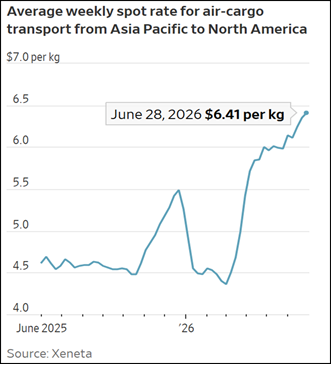
The Wall Street Journal (WSJ) reported that air freight demand and rates are surging as the construction of AI data centers in the U.S. has skyrocketed, intensifying competition among companies seeking to quickly import server racks and semiconductors produced in Asia by air, and making the assurance of supply chain speed a key challenge. Industry analysts estimate that air cargo volume from Asia to North America in May increased by about 20% year-over-year. As demand surged, rates also rose sharply; the report noted that as of June, the average air cargo rate from the Asia-Pacific region to North America had risen 36% compared to the same period last year. More companies are opting for air freight and paying high premiums to shorten delivery times. With continued expansion of AI infrastructure investment, the air cargo market is expected to see high demand and high freight rates for the foreseeable future.