
US Logistics Update [Jan 31, 2026]-English

President Trump has nominated former Fed Governor Kevin Warsh to chair the U.S. Federal Reserve, often called the “world's economic president.” Current Chairman Jerome Powell is scheduled to step down in May. Experts, including those on Wall Street, note that nominee Warsh has held key positions in both the market and government agencies, including his role as a Fed governor. Given his past hawkish stance on inflation control, (monetary tightening) stance on inflation control. They anticipate that if he becomes the next Fed Chair, the Fed is likely to cut interest rates in the short term. However, they also expect him to maintain the Fed's independence and pursue credible monetary policy in the long term. As he has long been considered the ‘safest choice’ among potential Fed Chair candidates, the nomination is being welcomed. Warsh, currently 55, graduated from Harvard Law School and has served as a director at the Federal Reserve from 2006 to 2011, following roles at Morgan Stanley and as an economic advisor to President George W. Bush. He was also considered for the Fed chair position during President Trump's first term in 2017. During his time as a Fed governor, he was reluctant to cut interest rates due to inflation concerns. However, he now advocates significantly reducing the Fed's balance sheet to withdraw liquidity, thereby creating conditions for interest rate cuts. Nevertheless, even if he becomes Chair, interest rate decisions are made by a vote of the Fed governors at FOMC meetings, making it unlikely he could freely alter monetary policy.

Meanwhile, the Federal Reserve (Fed) kept its benchmark interest rate unchanged at the current
range of 3.50-3.75% during its two-day Federal Open Market Committee (FOMC) meeting on the
27th and 28th. This marks the end of the consecutive rate cuts implemented in September,
October, and December of last year. Experts interpret this as the Fed adopting a cautious
approach to the pace of rate adjustments, judging that inflation risks from President Trump's
sweeping tariff impositions still exist. Indeed, the Fed explained, “While the unemployment rate
shows signs of stabilizing, inflation remains somewhat elevated,” particularly emphasizing its dual
goals of “maximum employment and inflation near 2%.”
U.S. producer prices, considered a leading indicator for consumer prices due to their eventual reflection in final consumer goods prices with a time lag, unexpectedly rose sharply in December last year. This has fueled concerns that U.S. companies may have begun passing on the costs of tariffs imposed by the Trump administration to consumers. The U.S. Bureau of Labor Statistics announced on the 30th that the U.S. Producer Price Index (PPI) rose 3.0% year-on-year and 0.5% month-on-month in December last year. This marks the highest increase in three months since September last year, exceeding the Dow Jones consensus forecast of 0.3%. The core PPI, excluding volatile energy and food, rose 3.5% year-on-year and 0.4% month-on-month.

Meanwhile, the Conference Board announced on the 27th that the U.S. Consumer Confidence
Index for January fell 9.7 points to 84.5 (base 1985=100) from 94.2 the previous month. This marks
the lowest level in approximately 12 years since May 2014 (82.2), worsening beyond pandemic
levels. Notably, the expectations index, reflecting consumers' short-term outlook, plunged 9.5 points
month-on-month to 65.1, indicating a collapse in consumer confidence. Typically, an expectations
index below 80 is considered a precursor to an economic downturn.
Last weekend's cold snap and heavy snowfall (‘Winter Storm Fern’) across the U.S. has effectively paralyzed major transportation networks, causing massive logistics disruptions. This storm has blanketed over 30-40 states from Texas to the Midwest, East Coast, and Northeast, with delays spreading across all segments—air, road, and last-mile delivery. UPS and FedEx warned of major processing delays as aircraft takeoffs and landings were restricted at key U.S. hubs (Louisville and Memphis). The USPS announced delivery suspensions or restrictions in 36 states. Notably, UPS stated that “service is operating only where possible” across the Midwest and Northeast, effectively acknowledging the difficulty of normal operations. FreightWaves reported that heavy snowfall from January 23-25 caused major highway closures, halted truck operations, and increased waiting times for refrigerated and frozen cargo. This is intensifying spot rate pressure in an already tight trucking market, with some regions reporting short-term rate spikes of 50-100%. Additionally, air cargo volumes have plummeted due to Winter Storm Fern. FedEx and UPS are experiencing massive delays in their Next-Day Air service due to backlogs at air hubs, with some regions even implementing temporary delivery embargoes. Notices to e-commerce sellers indicate that UPS, FedEx, and USPS are experiencing delivery delays in nearly 40 states. Specifically, the Texas–Midwest–Northeast corridor has shifted to limited operations for both pickup and delivery.

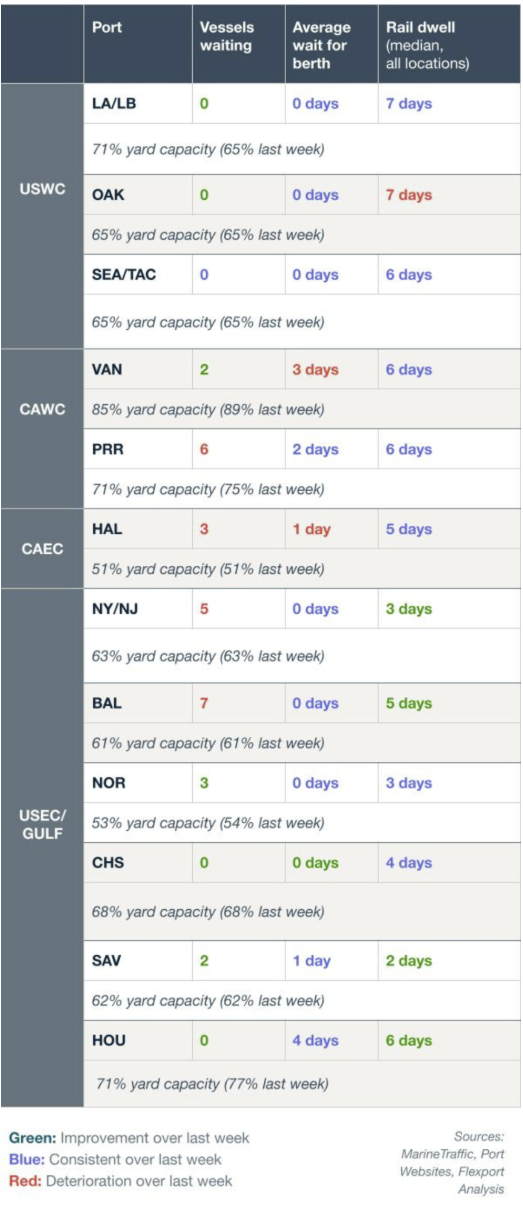
North American Vessel Dwell Times
Panama: APMT appointed as temporary operator after Hutchison's operating rights revoked
The Panama Supreme Court invalidated the operating rights for the Balboa and Cristobal terminals held by PPC (Panama Ports Company), a subsidiary of China's Hutchison, and designated APM Terminals, a subsidiary of MSC, as the temporary operator. PPC strongly opposed the ruling and announced plans for legal action both domestically and internationally. PPC had operated the Balboa and Cristobal terminals since 1997. The initial 25-year contract was extended in 2021, but this ruling invalidates the extension agreement itself. Hutchison had already agreed to sell both terminals to a consortium comprising BlackRock's Global Infrastructure Partners and MSC's subsidiary TiL (included in a global deal covering 43 terminals, valued at $22.8 billion). However, the transaction faces difficulties due to opposition from the Chinese government, citing ties between U.S. President Trump and BlackRock. Persistent disputes over operating rights and legal challenges could heighten concerns about schedule reliability and operational stability for shipping lines. As the Panama Canal is a key node connecting the Americas, Asia, and Europe, instability in its operation poses a risk factor for both shipping lines and cargo owners.
President Trump Nominates Laura DiBella as FMC Chairperson
The Federal Maritime Commission (FMC) announced that President Trump has nominated Laura DiBella as the new Chairperson of the FMC. DiBella, who was confirmed by the Senate in December 2025 and took office just three weeks ago as a new Commissioner, was nominated as Chairperson immediately upon her appointment to the Commission. Her term runs through June 2028. She brings maritime and port sector experience, having served as Director of Business Development for the Florida Department of Commerce, Executive Director of the Florida Port Pilots Association, and Port Director of Fernandina. In a statement, DiBella said, “I will focus on supporting the Trump administration's policies to rebuild America's shipping and maritime industries.” The FMC consists of five members, with one seat currently vacant. President Trump's nominee, Robert Harvey, is awaiting Senate confirmation. While the industry acknowledges DiBella's expertise as a seasoned port operations professional, there are concerns that her leadership may prioritize realignment with the ‘Trump shipping agenda’ over policy continuity compared to the previous chairman, Louis Sola.

Long Beach Port Pursues ‘Metro Express Terminal’ Specializing in E-Commerce
The Port of Long Beach, California, is developing a new container terminal to handle the growing volume of e-commerce cargo. Specifically, the Port of Long Beach is planning to construct an e-commerce dedicated terminal called the ‘Metro Express Terminal’ in the Pier S area. This terminal aims to dramatically increase the processing speed and turn-time of e-commerce cargo, thereby absorbing the growing volume of e-commerce shipments. The Port of Long Beach aims to gain competitiveness by minimizing delivery lead times—a key factor in e-commerce cargo competitiveness—not by increasing vessel “voyage speed” but by reducing dwell times inside and outside the terminal. It has also identified small and medium-sized independent carriers handling 9,000 TEU or less as its primary target customers to enhance processing efficiency. Industry estimates suggest full-scale operations will take approximately 3-5 years to complete. The terminal area is projected to be about 105 acres, with an annual handling capacity of up to 1.8 million TEUs. Regarding potential changes to the U.S. De Minimis duty exemption system (for goods valued under $800), a recent industry concern, the Port of Long Beach emphasized the stability of its business model, stating, “Even if the duty-free threshold is adjusted, the fundamental trend of large-scale e-commerce cargo arriving via sea containers is likely to persist.”
UPS Q4 2025 Revenue Down 3.2%... Amazon Contractions and Restructuring Accelerate
UPS announced Q4 2025 revenue of $24.5 billion (–3.2%) and operating profit of $2.6 billion (–12%). Alongside the earnings release, it detailed several restructuring initiatives and plans. First, it accelerated aircraft modernization by retiring its entire fleet of MD-11 aircraft. It also announced large-scale efficiency measures as its U.S. network restructuring intensified, including closing 93 buildings and automating 57 facilities. To reduce dependence on Amazon, UPS achieved its goal of cutting 1 million packages per day, resulting in annual cost savings of $3.5 billion. UPS declared it will continue its Amazon volume reduction (glide-down) strategy into 2026, aiming for an additional 1 million packages per day reduction. UPS stated this strategy aims to secure network elegance and transition to a high-margin customer-centric structure. Indeed, the share of its most profitable customers—small and medium shippers (31.8%) and B2B (42.3%)—is expanding, strengthening UPS's portfolio focused on its preferred high-margin customer segments. Meanwhile, the GroundSaver collaboration model with USPS has been restructured through a renewed contract with USPS, improving profitability compared to the previous SurePost model. UPS mentioned plans to continuously expand USPS-linked volumes going forward. The industry views the strengthened cooperation with USPS as a strategic move by UPS to externalize low-margin e-commerce volume while maintaining service coverage. However, analysis suggests that UPS's adherence to a “profit > volume” strategy, aggressively excluding unprofitable volume, makes price reductions unlikely and could weaken the bargaining power of e-commerce and retail companies.