
US Logistics Update [Aug 8, 2026]-English

On the 7th, the U.S. Bureau of Labor Statistics announced that the U.S. unemployment rate for July stood at 4.1%, down from 4.2% a month earlier, leading to the assessment that the U.S. employment situation remains strong. However, the number of jobs actually decreased by 23,000 compared to the previous month, indicating that the U.S. labor market is not as strong as expected. While a decline in the unemployment rate is typically a positive sign, it can also suggest that more people have given up looking for work and dropped out of the labor force. Experts point out that the decrease in employment despite the lower unemployment rate is due to the labor force participation rate falling from 61.5% in June to 61.4% in July. In fact, July’s labor force participation rate was the lowest since February 2021 (61.4%), during the pandemic. Recently, the U.S. labor market has maintained a relatively stable “no hire, no fire” environment, with job growth slowing while layoffs have remained at historically low levels; however, with employment unexpectedly declining in July, concerns about a potential weakening of the labor market are expected to resurface. However, the market interpreted the poor employment data as good news for interest rates, and the New York stock market hit a record high. This was driven less by a strong economy and more by expectations that the Fed would find it difficult to raise interest rates further given the weakening job market.

According to a CNN poll conducted on the 30th, about 100 days before the U.S. midterm elections, the Democratic Party leads the Republican Party 48% to 40%, securing a lead outside the margin of error; in particular, the Democrats hold a significant 20-point lead among likely voters. CNN analyzed this as the result of two interlocking factors: growing voter dissatisfaction with Congress (with a majority of respondents stating that “replacing most incumbent lawmakers would be helpful”) and anti-Trump sentiment leading to the consolidation of the Democratic base (70% of Democratic supporters say they are “voting against Trump”). Meanwhile, within the Democratic Party, the influence of young politicians who are members of or aligned with the Democratic Socialists of America (DSA) has been steadily growing. Their characteristics are as follows:
• They demand a hard-line progressive stance on issues such as climate, housing, labor, and anti-
war policies
• Policy clashes with the party’s traditional centrist and moderate factions are intensifying
• High support among young voters
• Increasing instances of these candidates outperforming centrists in primary elections due to
their strong district-level bases
This trend is exerting pressure to pull the Democratic Party’s policy direction further to the left, raising concerns that while the party may win the midterm elections, it will fail to secure victory in the crucial presidential election due to the alienation of moderate voters. Furthermore, California Governor Gavin Newsom, the frontrunner for the Democratic presidential nomination, has reached a limit in his ability to win over a broad base of voters due to a lack of tangible achievements—including deteriorating economic conditions and public safety—during his tenures as Mayor of San Francisco and Governor of California.

North American Vessel Dwell Times

Taiwanese LED Manufacturer Agrees to Pay $5.15 Million Fine for Alleged Tariff Evasion… A Sign of Tighter U.S. Supply Chain Enforcement
As the U.S. Customs and Border Protection (CBP) steps up enforcement across the supply chain, a Taiwanese LED manufacturer has admitted to allegations of tariff evasion and agreed to pay a settlement of $5.15 million. This action demonstrates that the U.S. government is taking a tougher stance on violations of trade regulations. The company was accused of evading tariffs during the U.S. import process, and CBP reached a settlement following an investigation. Industry observers view this case as more than just an isolated violation; they see it as a signal that the U.S. is intensifying its scrutiny of Asian manufacturers as a whole. In particular, CBP has recently intensified audits of CTPAT-certified companies, and document verification related to the UFLPA (Uyghur Forced Labor Prevention Act) has also become significantly stricter. Experts point out that, in response to the U.S.’s tightening of tariff and forced labor regulations, companies need to establish more rigorous compliance systems regarding proof of origin, supply chain transparency, and HTS code classification.
SeaLead, Rocked by Allegations of Ties to Iran, Suspends Operations Immediately After U.S. Sanctions and Enters Voluntary Liquidation
Singapore-based shipping company SeaLead Shipping suspended all operations and entered voluntary liquidation proceedings just weeks after the U.S. Treasury Department announced sanctions. This action followed a statement by the Office of Foreign Assets Control (OFAC) that SeaLead and its affiliates had transported illegal cargo in connection with Iran’s Shamkhani network; the sanctions applied not only to the company but also to the three container ships operated by SeaLead. SeaLead had once grown to become the world’s 13th-largest shipping company, operating 53 vessels with a capacity of over 200,000 TEU, but following the sanctions, it faced the fate of disappearing overnight due to the suspension of operations on major routes and the termination of charter agreements.

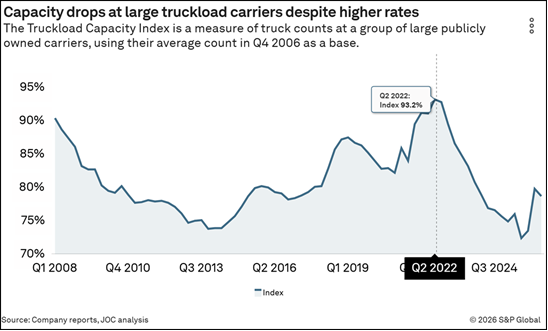
AI Data Center Construction Is Rapidly Eroding the U.S. Truck Supply
The JOC reports that the proliferation of AI is causing a surge in data center construction across the United States, putting even more pressure on an already dwindling U.S. truck supply. Building a 1 GW data center requires 100,000 trucks, and U.S. data center capacity is projected to surge from 24 GW to 110 GW between 2026 and 2030. The problem, however, is that the supply of trucks is actually decreasing. Major trucking companies have reduced their truck fleets by 15.5% since 2022, while the industry as a whole has seen a 2.4% reduction in supply, compounded by a 10% increase in vehicle idling. Data center construction requires the transport of all major materials—such as generators, transformers, and steel structures—via heavy-duty trucks, leading to a sharp increase in demand for open-deck and flatbed trailers. Meanwhile, reports indicate that while political backlash has led to over 300 bans or moratoriums on data center construction in some regions, this has not reduced demand but has instead shifted it to new areas such as North Dakota. As a result, trucks are moving to regions that previously had no shippers, leading to the adverse effect of further dispersing and reducing the available supply.
U.S. Court of Appeals Upholds FMC’s Ruling on ‘Unreasonable Detention Charges’…
The U.S. Court of Appeals for the District of Columbia recently upheld all of the FMC’s previous rulings in a lawsuit filed by Evergreen Shipping Agency, finding that detention charges imposed during periods when ports were closed for holidays—preventing trucking companies from returning containers—were “unreasonable.” The court upheld the application of the FMC’s Interpretive Rule on Detention and Demurrage, reaffirming the principle that detention and demurrage charges must serve as incentives to promote “freight fluidity.” With this ruling, shipping lines are expected to be required to provide clear cost justifications and demonstrate the reasonableness of such charges when imposing detention and demurrage fees in the future. Attention is now focused on whether this will put an end to the imposition of unreasonable detention and demurrage charges by shipping lines and terminals.
PierPass at the Ports of Los Angeles and Long Beach to Increase by 4.77% Effective August 1
The West Coast Marine Terminal Operators Agreement (WCMTOA) announced a 4.77% increase in the PierPass TMF effective August 1, 2026. Accordingly, the TMF will be adjusted from $38.78 to $40.63 per TEU and from $77.56 to $81.26 per FEU. PierPass refers to the “Traffic Mitigation Program” introduced to reduce congestion at the Ports of Los Angeles and Long Beach (LA/LB) and the associated fee (TMF: Traffic Mitigation Fee). The program aims to reduce port congestion by dispersing truck traffic that is concentrated during daytime hours. To achieve this, the program expands nighttime and weekend (off-peak) operations and imposes an additional fee (TMF) on cargo using the terminals during daytime hours to spread out truck traffic.

AI Data Center Boom Is Reshaping the Global Logistics Landscape for Forwarders and Airlines
JOC reports that as the construction of AI data centers explodes, particularly in the U.S., global freight forwarders are expanding their businesses beyond simple air freight to include high-value-added logistics services such as installation, warehousing, and parts management. For example, DHL announced that, in line with the construction of large-scale data centers in the U.S., it is providing not only international transportation but also on-site material staging, sequencing, and installation services. Additionally, Synergy Research forecasts that the total capacity of U.S. data centers will double within three years, noting that there are currently 5,000 in operation and 700 under development. The firm analyzes that high-value equipment such as AI servers, GPUs, and memory—which have a value density more than 10 times higher than that of e-commerce goods—is significantly improving the profitability of air freight rates. In fact, South Korean and Taiwanese airlines saw their second-quarter cargo revenue increase by more than 40% due to demand for AI servers, and Cathay Pacific also reported a 24% rise in cargo revenue driven by growing demand for semiconductors and AI infrastructure. Experts believe that demand for equipment from AI hyperscalers will persist over the long term and expect this trend to expand into new markets such as the Middle East and Africa, despite data center construction regulations in some regions.