
US Logistics Update [Aug 1, 2026]-English

At its regular Federal Open Market Committee (FOMC) meeting that concluded on the 29th, the Federal Reserve (Fed) kept the benchmark interest rate unchanged at 3.50–3.75%. This marks the fifth consecutive rate freeze, following those in January, March, April, and June of this year. However, unlike the unanimous decision to keep rates unchanged at the June FOMC meeting, the Fed announced that this decision was made by a vote of 9 in favor and 3 against among the 12 FOMC members; experts interpret this as effectively a “hawkish (monetary tightening-oriented) hold.” As the rate freeze was widely anticipated by experts, it did not shock the market; however, the market views it as highly likely that the Fed will implement a 0.25 percentage point rate hike this coming September, and the CME (Chicago Mercantile Exchange) FedWatch tool reflects a probability of approximately 72% that the Fed will raise rates in September. Meanwhile, the three members who voted against the decision unanimously emphasized that “the longer high inflation persists, the greater the cost and the more difficult it becomes to bring it back down,” adding that “now is the time for the FOMC to take action to quickly return the Personal Consumption Expenditures (PCE) inflation rate to the 2% target.” Unless inflation falls to a meaningful level, it is highly likely that the Fed will raise interest rates at its September meeting.


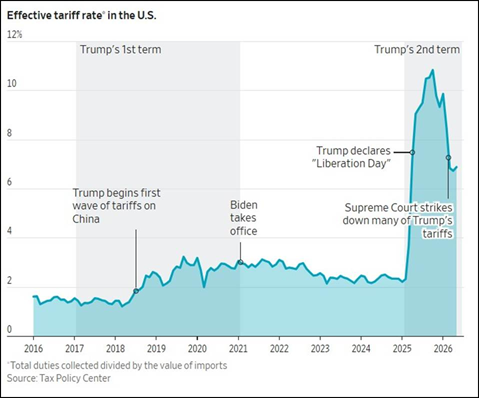
The Wall Street Journal reported that many U.S. corporate executives expect high tariffs to become a “permanent institution” even after President Trump leaves office in January 2029. The analysis suggests that because the U.S. generates between $20 billion and $30 billion in revenue each month from tariffs, it will be difficult for the next president to forgo this tax revenue. The report also explains that many companies have already undergone major supply chain restructuring, making it difficult to revert to the previous state. Industry experts predict that tariffs are likely to become the “new normal” rather than a temporary policy that appears or disappears with a change in administration.

North American Vessel Dwell Times

U.S. Rail Freight Trends in 2026
U.S. rail freight in 2026 is projected to increase by 3.4% year-over-year, recovering to pre-pandemic peak levels. According to the analysis “The State of Rail Freight 2026” released on July 29 by WSI (Warehouse Specialists Inc.), a U.S.-based logistics and warehouse operations data analytics firm, 14 out of 20 major rail freight categories are expected to see growth. The analysis confirmed expanding demand across the industry, with grain up 12% and steel scrap up 10.6% (see table below). The federal agency STB (Surface Transportation Board) has finally begun disclosing OETA (On-Time Arrival Accuracy) and ISP (Spot and Pool Accuracy) figures starting this year, making it possible to compare service quality. According to WSI data, average processing times at some regional yards and gateways increased by 5–12%, and demurrage costs have risen by 8–15% year-over-year, indicating that rail service quality is deteriorating. In particular, the analysis found that delays in coordination with warehouses and trucks account for 30–40% of the total lead time, suggesting significant issues are arising during the rail connection process. Delays are also frequent in vessel-to-rail connections; in fact, rail connections in LA and LGB take an average of 7 days (see the “Rail Dwell” column in the table above), and there are a growing number of cases where shippers are abandoning rail connections due to delays exceeding one week and switching to truck transport instead. WSI emphasizes that the risk of cost increases due to operational shortcomings—such as demurrage, release times, and misbilling—is high, and that service disparities are growing by region and carrier. Consequently, competitiveness varies significantly based on logistics operational capabilities rather than rail transport itself; therefore, identifying and selecting a competitive logistics partner to handle operations is of utmost importance. Meanwhile, rail currently handles 40% of long-haul freight in the U.S.

Pacific Routes Face Test of Whether “Early Peak Season” Will Continue After August 1 GRI
The JOC reported that as major carriers on the Pacific route announced new GRIs of over $1,000 per FEU effective August 1, the market’s primary focus has shifted to whether the momentum of the early peak season will hold. Although major U.S. retailers had anticipated reducing imports starting in August, contrary to these expectations, spot rates on the North Asia–U.S. West Coast route rose 1% week-over-week to $5,850/FEU as of July 28, halting the downward trend, while rates on the U.S. East Coast fell by only 1% to $8,850/FEU, remaining at a high level. Shipping lines believe this GRI will be “sticky”—unlike those in the spring—and forwarders also assess that “demand is stronger than expected.” Forwarders expect that after the GRI is applied, spot and FAK rates will rise to $7,000–7,200 per FEU on the U.S. West Coast and $10,000–10,200 per FEU on the U.S. East Coast—the highest levels on the East Coast in the past two years. Shipping lines cite several factors behind the strong demand, including restocking due to inventory shortages, inaccurate initial demand forecasts by retailers, increased imports of hardware for AI data centers, and expanded defense spending. Contrary to the outlook for increased demand, supply from Asia to the U.S. West Coast in August is expected to decrease by about 3% month-over-month, which is likely to intensify upward pressure on freight rates. Meanwhile, the share of NVO bookings has increased to 53.5%, indicating a shift in the market structure toward NVO-centric operations. Meanwhile, JOC reports that concerns are growing over reduced water depths in the Panama Canal due to El Niño, raising the possibility that slot auctions could reach $1 million to $1.6 million and potentially exceed $3 million in the future; it also notes that some carriers have already announced Panama Canal surcharges.

U.S. Inventory Drawdown Accelerates… Expectations for Restocking Demand Grow
As U.S. companies rapidly draw down their inventories, expectations for future restocking demand are growing. According to WSI (Warehouse Specialists Inc.), a provider of industrial logistics data, the U.S. inventory-to-sales ratio in May stood at 1.28, marking its lowest level since 2021. Analysts interpret this as a sign that manufacturers and distributors have significantly depleted their inventories, which is likely to lead to future restocking demand. Manufacturing indicators also remain in an expansionary phase, with the U.S. ISM (Institute for Supply Management) Manufacturing PMI (Purchasing Managers’ Index) at 53.3 and the S&P Global Manufacturing PMI at 53.9—both above the benchmark of 50.

China: Port Operations Disrupted by Typhoons as Super Typhoon Dolphin Approaches
East Asia is experiencing major disruptions to port operations due to a series of consecutive typhoons. Typhoon Noul caused major terminals and depots in Hong Kong and Shenzhen to suspend operations for up to 38 hours, while the East China region continues to face widespread delays due to the lingering effects of the previous typhoon, Bavi. The average delay at the Port of Shanghai has reached five days, with some terminals experiencing delays of up to eight days; as of July 20, the number of vessels waiting in line has risen to 127—more than double the figure from the beginning of the month. With another powerful typhoon, Dolphin, expected to hit East Asia next week, further delays and disruptions are inevitable.

CBP (U.S. Customs and Border Protection) Tightens Security Inspections, Leading to a Sharp Rise in Demurrage Costs
As the U.S. CBP has significantly tightened security inspections of import and export containers, cargo holds at ports have increased, and shippers and forwarders are facing a substantial rise in unexpected demurrage costs. The industry describes this as “the strictest enforcement since 9/11.” In particular, following President Trump’s executive order on June 3, CBP has significantly increased cargo holds targeting importers with overseas headquarters. If a shipment is subject to a physical inspection, delays of several days to several weeks occur, and in some regions, $8,000 to $12,000 in hold and storage fees in some areas, and there have been instances where an entire bundle under the same bill of lading (BL) was held together, resulting in reported costs of up to $45,000 for a single shipment. The industry argues that “imposing demurrage when shippers cannot retrieve containers due to government-imposed holds violates the ‘incentive principle’” and is calling for strong regulatory action from the FMC. On the other hand, port operators argue that “compliance with regulations is the shipper’s responsibility, and the detention period should be included in demurrage calculations,” reigniting the debate over demurrage.

Airlines Begin Raising Fuel Surcharges Amid Surge in Jet Fuel Prices
With global jet fuel prices rising 35% compared to the first week of July, airlines are successively raising their cargo fuel surcharges. As oil prices rebounded due to renewed tensions in the Middle East, the average price of jet fuel rose to $160.06 per barrel as of July 24, a significant increase from $119.13 per barrel earlier this month. In response, Cathay Pacific announced a 50–55% increase in cargo surcharges for long-haul, medium-haul, and short-haul routes effective August 1, while EVA Air also raised surcharges for long-haul routes by 20% on the same day. While major Asian airlines such as ANA and JAL are joining the trend of increases, Korean Air announced a reduction in surcharges for the third consecutive month. Despite the sharp rise in fuel prices, air freight rates have remained relatively stable, with rates for China–North America at $6.36/kg and China–Europe at $5.03/kg—a slight decrease compared to early July. According to Freightos, U.S.–China freight rates also fell from $6.56/kg to $5.72/kg. The industry expects that pressure to raise rates will soon be reflected in the market, as airlines’ operating costs are rising due to higher fuel costs and the suspension of Middle Eastern air routes.

U.S. Government Begins Full-Scale Support for JetZero’s ‘Blended-Wing’ Passenger Aircraft Development
With the U.S. government backing next-generation aircraft startup JetZero, the likelihood of a new competitor emerging in the U.S. commercial aircraft market—long dominated by Boeing—is increasing. JetZero recently secured a preliminary agreement for loans and guarantees totaling up to $3 billion from the U.S. Export-Import Bank (EXIM Bank) and has also received $235 million in funding from the U.S. Air Force. Northrop Grumman and RTX (Pratt & Whitney engines) are also participating as development partners, and interest from airlines is high, with more than 20 carriers—including Delta, Alaska, and United—taking part in technical reviews; United, in particular, has placed a conditional order for up to 200 aircraft. The Z4, currently under development by JetZero, differs from conventional cylindrical airframes in that it features a “blended wing” structure where the wings and fuselage are integrated into a single unit. Based on a high-efficiency design that NASA has been researching for decades, the Z4 is expected to deliver approximately 30% better fuel efficiency than the latest aircraft models. With a seating capacity of approximately 250 and a range of 5,000 nautical miles, the Z4 is targeting the mid-range market previously served by the B757 and B767. Although the blended-wing design still faces many challenges—such as passengers’ perception of gravity, the absence of windows, emergency evacuation routes, and compatibility with airport infrastructure—construction of the first production facility in North Carolina has already begun this year. The company aims to have the prototype make its first flight by the end of 2027 and begin commercial operations in the early 2030s.

FedEx to Raise Surcharges for 2026 Year-End Peak Season Shipments
FedEx announced that, ahead of the 2026 year-end peak season, it will increase the new Demand Surcharge and existing peak season surcharges across its entire U.S. package delivery service. These surcharges are scheduled to be implemented in phases from September 28, 2026, through January 17, 2027. As a result of this measure, the Additional Handling Surcharge will increase to a maximum of $11.85 per package, the Oversize Charge will rise to a maximum of $117.25, and the Ground Unauthorized Package Charge will be levied at up to $595. FedEx Ground Residential and FedEx Home Delivery Residential services will incur an additional charge of up to $0.80 per package, while FedEx Ground Economy service will incur an additional charge of up to $4.05. FedEx explained that it is applying these demand-based surcharges to reflect increased shipment volumes, strain on network capacity, and rising operating costs. Industry observers predict that, following FedEx’s preemptive rate hike, the majority of carriers will follow suit with their own rate increases.